


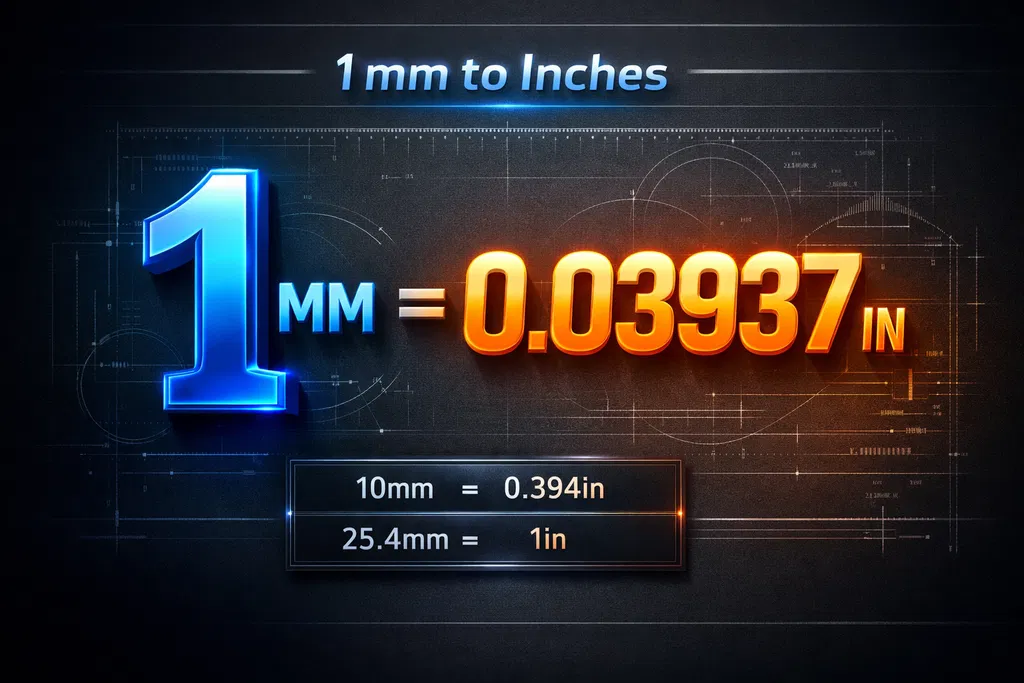
Conversions between millimeters and inches seem simple at first, yet they quietly power everything from engineering drawings to everyday measurements. You might not think about it while checking the size of a screw or reading a product label, but behind the scenes, this small conversion plays a big role in accuracy.
The core relationship is easy to remember.
1 millimeter equals approximately 0.0393701 inches.
That number might look oddly specific, but it exists for a reason. Once you understand where it comes from and how to use it, conversions stop feeling like math and start feeling like a useful tool.
Why Millimeters and Inches Both Exist
Before diving into formulas, it helps to understand why two systems are still in use.
Millimeters belong to the metric system, which is widely used around the world. It is structured, logical, and based on powers of ten. Inches, on the other hand, come from the imperial system, which developed historically and is still common in countries like the United States.
This mix of systems is why conversions are necessary. You might design something in millimeters but manufacture or measure it in inches.
The Exact Conversion Formula
The relationship between millimeters and inches is defined precisely, not estimated.
Standard Conversion
| Unit | Equivalent |
| 1 inch | 25.4 millimeters |
| 1 millimeter | 0.0393701 inches |
This exact value comes from international measurement standards, ensuring consistency across industries.
Simple Version for Daily Use
For quick calculations, most people round the value:
- 1 mm ≈ 0.0394 inches
This rounded figure is easier to remember and works well in non-critical situations.
Converting Millimeters to Inches Step by Step
The process itself is straightforward. You multiply the millimeter value by the conversion factor.
Example Calculation
Suppose you have a length of 100 mm.
| Step | Calculation |
| Multiply | 100 × 0.0393701 |
| Result | 3.93701 inches |
So, 100 mm is just under 4 inches.
This kind of conversion appears often in real scenarios, especially when switching between product specifications or design measurements.
Converting Inches Back to Millimeters
Sometimes you need to go in the opposite direction. The method is just as simple, but the factor changes.
Reverse Formula
- 1 inch = 25.4 mm
Example Calculation
If an object measures 5 inches:
| Step | Calculation |
| Multiply | 5 × 25.4 |
| Result | 127 mm |
This reverse conversion is especially useful when working with tools or materials labeled in inches but required in metric units.
Practical Examples That Make It Click
Conversions feel more natural when tied to real objects rather than abstract numbers.
Imagine stacking five standard coffee mugs. Their combined height might be close to 5 inches. In millimeters, that becomes roughly 127 mm.
Or think about a smartphone thickness measured at around 8 mm. In inches, that is approximately 0.31 inches, which helps give a better sense of scale if you are used to imperial units.
These small mental comparisons make conversions easier to visualize.
Quick Reference Table for Common Values
Instead of calculating every time, a quick table can save effort.
Millimeters to Inches
| Millimeters | Inches |
| 1 mm | 0.039 in |
| 10 mm | 0.394 in |
| 50 mm | 1.97 in |
| 100 mm | 3.94 in |
| 200 mm | 7.87 in |
Inches to Millimeters
| Inches | Millimeters |
| 1 in | 25.4 mm |
| 2 in | 50.8 mm |
| 5 in | 127 mm |
| 10 in | 254 mm |
Having these reference points reduces the need for repeated calculations.
Where This Conversion Is Used
This is not just theoretical. It shows up in many practical areas.
Common Applications
- Engineering and manufacturing
- Product design and prototyping
- Construction and woodworking
- Mechanical parts and tools
- Everyday measurements like screen sizes or furniture
In these fields, even a small error can cause problems, which is why accurate conversion matters.
Why Precision Matters
At a casual level, rounding is fine. But in technical work, even a slight difference can create issues.
For example, rounding 0.0393701 to 0.04 might not seem like a big deal. But over larger measurements, that difference adds up. In engineering, that could affect alignment, fit, or function.
When to Use Exact Values
- Technical drawings
- Manufacturing specifications
- Scientific calculations
When Rounding Is Acceptable
- Everyday use
- Rough measurements
- Quick estimates
Knowing when to be precise is just as important as knowing the formula itself.
Simple Mental Math Trick
If you need a quick estimate without a calculator, you can use a rough shortcut.
Approximation Method
- Divide millimeters by 25 to get inches
For example:
- 100 mm ÷ 25 ≈ 4 inches
This is not exact, but it is close enough for quick thinking.
Common Mistakes to Avoid
Even simple conversions can lead to confusion if a few details are overlooked.
Frequent Errors
- Mixing up millimeters and centimeters
- Using incorrect rounding values
- Forgetting which direction the conversion goes
- Applying the wrong formula
A small mistake in units can lead to a completely wrong measurement, so it is always worth double-checking.
The Relationship Between Metric and Imperial Systems
Millimeters and inches are part of two different systems, but conversions like this act as a bridge.
The metric system offers simplicity and consistency. The imperial system offers familiarity in certain regions. Instead of choosing one over the other, understanding both gives flexibility.
That flexibility becomes especially valuable when working across international standards.
Final Thoughts
The conversion from millimeters to inches may seem like a small detail, but it carries a lot of practical value. Once you understand that 1 mm equals approximately 0.0393701 inches, everything else builds from that point.
Whether you are measuring a small object, working on a design, or just trying to make sense of product specifications, this knowledge makes things clearer.
And over time, these numbers stop feeling like formulas. They start becoming intuitive, almost automatic. That is when you know the concept has truly clicked.
