


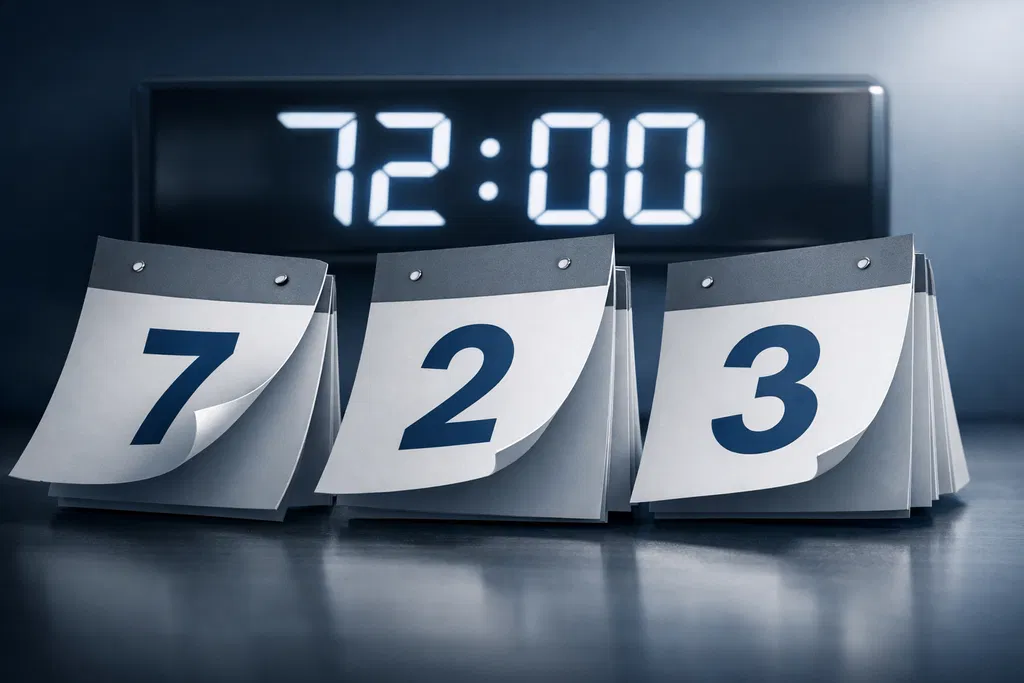
Time conversions appear simple, yet they often raise surprisingly common questions. One example is how many days 72 hours equals. Whether someone is planning a trip, tracking a project deadline, or waiting for a response, converting hours into days can make timeframes easier to understand.
The short answer is straightforward: 72 hours equals 3 days. However, understanding how that calculation works and how it applies to real-life situations can make scheduling and planning far easier.
Understanding the Basic Time Conversion
The relationship between hours and days follows a fixed global time standard. A full day always contains 24 hours.
Key Time Units
| Time Unit | Equivalent |
| 1 day | 24 hours |
| 2 days | 48 hours |
| 3 days | 72 hours |
To determine how many days are in 72 hours, simply divide the total hours by the number of hours in one day.
72÷24=372 \div 24 = 372÷24=3
This means 72 hours equals exactly three full days.
Breaking Down the Calculation Step by Step
Understanding the math behind the conversion makes it easier to apply in different situations.
Step-by-Step Calculation
- A single day contains 24 hours
- Multiply 24 hours by the number of days
- Compare the result with the total hours
Example:
- 24 hours × 3 days = 72 hours
This confirms that 72 hours is equal to three complete days.
Why Knowing This Conversion Is Useful
Although the math is simple, converting hours into days helps people better visualize longer time periods.
Common Situations Where 72 Hours Matters
People frequently encounter this timeframe in everyday life:
- Travel plans – A 72-hour trip equals a three-day vacation
- Shipping or delivery windows – Many services promise delivery within 72 hours
- Project deadlines – A task due in 72 hours means completion within three days
- Medical or testing results – Some labs provide results within this timeframe
Thinking in days rather than hours often makes scheduling clearer and easier to manage.
Visualizing a 72-Hour Timeline
To better understand how 72 hours fits into a schedule, consider this example timeline.
Example Time Breakdown
| Day | Time Period |
| Day 1 | Hour 1 – Hour 24 |
| Day 2 | Hour 25 – Hour 48 |
| Day 3 | Hour 49 – Hour 72 |
After the 72nd hour passes, exactly three full days have elapsed.
Real-Life Examples of 72 Hours
Sometimes numbers feel abstract until they’re connected to real situations.
Example 1: Waiting for a Response
If someone says they will reply in 72 hours:
- Monday at 10:00 AM → Reply expected by Thursday at 10:00 AM
Example 2: A Weekend Trip
A short getaway starting Friday morning could last:
- Friday
- Saturday
- Sunday
That entire period equals 72 hours of travel time.
Example 3: Work Deadlines
A manager assigning a task with a 72-hour deadline effectively gives employees three full days to complete the assignment.
Quick Hour-to-Day Conversion Reference
For quick calculations, the following table helps visualize similar time conversions.
| Hours | Equivalent Days |
| 24 hours | 1 day |
| 48 hours | 2 days |
| 72 hours | 3 days |
| 96 hours | 4 days |
| 120 hours | 5 days |
This simple reference helps when estimating deadlines, travel duration, or delivery schedules.
Why Time Sometimes Feels Longer or Shorter
Interestingly, while 72 hours always equals three days mathematically, our perception of time can vary.
For example:
- A relaxing vacation weekend may feel like it flies by.
- Waiting for important news might make the same 72 hours feel endlessly long.
In reality, the clock remains constant only our experience of time changes.
Final Thoughts
The conversion is simple: 72 hours equals exactly 3 days. This calculation comes from dividing the total hours by the 24 hours that make up a single day.
Understanding this basic time relationship helps with planning trips, meeting deadlines, scheduling projects, and estimating waiting periods. And while three days may sometimes feel short or painfully long depending on the situation the math behind it never changes.
Next time someone mentions 72 hours, you’ll know immediately: that’s just three full days on the clock.
