


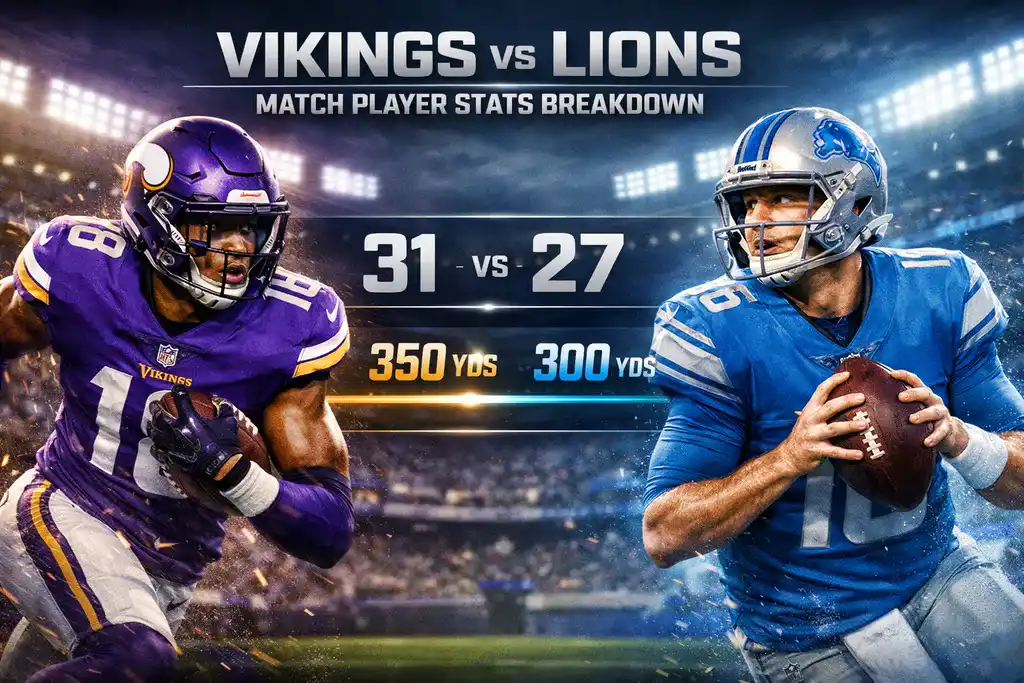
Some games feel routine. This one did not. When the Minnesota Vikings faced the Detroit Lions, it had the kind of intensity that keeps fans leaning forward without realizing it. The scoreboard stayed tight, the momentum kept shifting, and individual performances quietly shaped every quarter.
The final score, 31 to 27, tells you it was close. It does not tell you how it got there. For that, you need to look deeper into the player stats, decisions, and those small moments that rarely make headlines but often decide games.
Match Overview and Key Highlights
The matchup brought together two teams fighting for control within their division. Both offenses showed confidence early, and neither defense managed to fully settle the game down.
Minnesota leaned on its passing game with precision and timing. Detroit responded with balance, mixing strong passing with an effective rushing attack. The result was a back-and-forth contest where neither side could afford a mistake.
Quick Match Summary
| Category | Minnesota Vikings | Detroit Lions |
| Final Score | 31 | 27 |
| Passing Yards | 350 | 300 |
| Rushing Impact | Moderate | Strong |
| Turnovers | Minimal | Minimal |
The numbers already hint at the story. Minnesota pushed through the air, while Detroit found rhythm on the ground.
Quarterback Performance Analysis
Quarterbacks often carry the narrative of a game, and this matchup was no different. Both players delivered, but in slightly different ways.
Kirk Cousins Performance
Kirk Cousins played with control and awareness. His numbers reflect not just volume, but efficiency under pressure.
- 28 completions out of 40 attempts
- 350 passing yards
- 3 touchdown passes
What stood out was his ability to read defensive coverage quickly. He did not force throws unnecessarily. Instead, he trusted his receivers and took advantage of openings as they appeared.
There was a certain rhythm to his game. Once he found it, the Vikings’ offense became difficult to contain.
Jared Goff Performance
Jared Goff matched that composure on the other side. His performance was slightly more conservative but equally effective.
- 26 completions out of 34 attempts
- 300 passing yards
- 2 touchdown passes
Goff’s strength in this game was decision-making. He avoided risky plays and kept drives alive. His timing, especially on deeper routes, created some of Detroit’s most exciting moments.
Wide Receiver Impact and Key Connections
A quarterback’s performance often reflects the quality of connection with receivers. In this game, both teams had standout contributors.
Justin Jefferson’s Dominance
Justin Jefferson once again proved why he is one of the most reliable targets on the field.
- 9 receptions
- 150 receiving yards
- 2 touchdowns
His route running created separation, but it was his awareness that stood out. He consistently found space even when coverage looked tight.
At times, it felt like the connection between him and Cousins required no adjustment. The timing simply worked.
Amon-Ra St. Brown’s Big Play Moment
Amon-Ra St. Brown delivered one of the most memorable plays of the game.
- Key deep touchdown reception
- Consistent yard gains across drives
His ability to turn a single opportunity into a scoring play shifted momentum. It also exposed gaps in Minnesota’s defensive coverage.
Rushing Game and Ground Control
While passing dominated the headlines, the ground game quietly influenced the flow of the match.
David Montgomery’s Contribution
Detroit’s rushing attack leaned heavily on David Montgomery, and it paid off.
- Over 100 rushing yards
- 15 carries
- Strong yard-per-carry average
His running style combined speed with balance. He did not rely purely on power or agility. Instead, he adapted based on defensive positioning.
That flexibility made him difficult to stop, especially during critical drives.
Comparison of Offensive Styles
| Aspect | Vikings | Lions |
| Primary Strength | Passing | Balanced |
| Key Driver | Cousins to Jefferson | Goff and Montgomery |
| Play Style | Vertical attack | Mixed approach |
The contrast in styles made the game more dynamic. Each team forced the other to adjust.
Defensive Performance and Gaps
Neither defense completely controlled the game, but both had moments that mattered.
Vikings Defensive Effort
Minnesota’s defense showed flashes of effectiveness.
- 2 sacks on Jared Goff
- Occasional pressure in key moments
However, consistency was an issue. Detroit’s running game exposed gaps, especially in open-field tackling.
Lions Defensive Challenges
Detroit’s defense struggled more against the passing game.
- Difficulty containing deep routes
- Trouble limiting Jefferson’s impact
While they managed to stay competitive, their inability to shut down big plays ultimately cost them.
Turning Points That Shaped the Game
Every close match has a few moments that quietly shift the outcome.
Key Game-Changing Factors
- Jefferson’s second touchdown extended Minnesota’s lead
- St. Brown’s deep touchdown kept Detroit within reach
- Late-game drives increased pressure on both defenses
The final minutes carried that familiar tension where every play feels decisive. Minnesota managed to hold its edge, but it was far from comfortable.
Statistical Breakdown of Key Players
| Player | Team | Key Stats |
| Kirk Cousins | Vikings | 350 yards, 3 TD |
| Justin Jefferson | Vikings | 150 yards, 2 TD |
| Jared Goff | Lions | 300 yards, 2 TD |
| Amon-Ra St. Brown | Lions | Key TD reception |
| David Montgomery | Lions | 100+ rushing yards |
This table summarizes performance, but it does not capture the full intensity behind each play.
What This Game Reveals Moving Forward
This matchup highlights a few important insights for both teams.
Minnesota’s passing game is clearly a strength, especially when timing and execution align. If maintained, it can challenge even stronger defenses.
Detroit, on the other hand, showed versatility. Their ability to combine passing and rushing keeps them unpredictable. However, defensive consistency remains an area to improve.
Final Thoughts
The Minnesota Vikings vs Detroit Lions game was not just about numbers. It was about how those numbers came together in real time.
A few more successful tackles, a slightly different defensive read, or one missed connection could have changed the result entirely. That is what makes close games memorable.
In the end, Minnesota secured the win with a narrow margin, but both teams walked away with performances worth analyzing. And for anyone watching, it was the kind of game that reminds you why small details in football often carry the biggest impact.
