


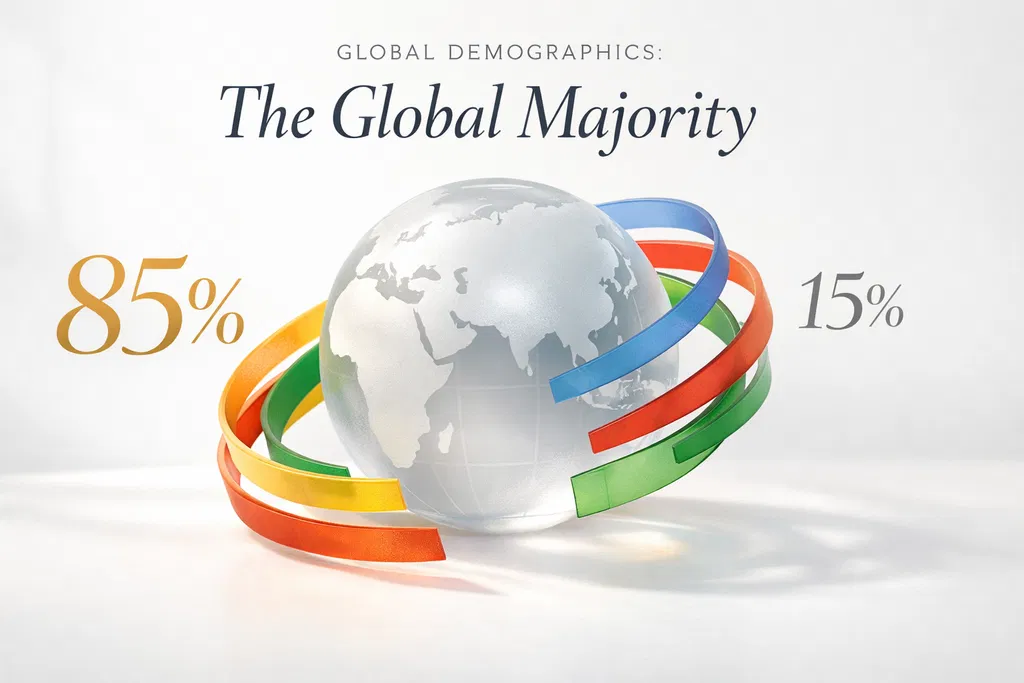
If you ask a random person to guess the percentage of white people in the world, chances are the answer will be much higher than reality. It is an easy mistake to make. Media, history books, and popular culture often give a very narrow view of global populations.
The truth is more interesting, and honestly, a bit surprising. White people make up a relatively small portion of the global population, while the vast majority of humanity belongs to diverse ethnic and racial groups across Asia, Africa, and Latin America. Understanding this shifts how we see the world, and sometimes even how we see ourselves.
Let’s break this down carefully, with real numbers, context, and a bit of perspective.
Global Population Breakdown by Race and Ethnicity
What Percentage of White People Are in the World?
Current global estimates suggest that white people make up roughly:
- 11 percent to 16 percent of the global population
This range exists because definitions of race and ethnicity vary across countries and data sources. Some include broader European-descended populations, while others use stricter classifications.
Now compare that with other groups:
- Asian populations: Around 4.6 billion people
- Black populations: Around 1.9 billion people
- People of mixed or other ethnic backgrounds: Growing rapidly
This means that:
- Around 84 percent to 89 percent of the world is Person of Color (PoC)
That alone changes the narrative many people grow up with.
What Does “Global Majority” Actually Mean?
Understanding the Concept
The term People of the Global Majority refers to all groups who are not classified as white in traditional racial frameworks. This includes:
- Black populations across Africa and the diaspora
- Indigenous communities worldwide
- South Asian, East Asian, and Southeast Asian populations
- Middle Eastern and North African groups
- Latin American populations, including Afro-Latino and Indigenous groups
- Pacific Islanders and Native communities
It is not a perfect label, but it reflects a simple fact:
- Most people in the world are not white
Why This Term Matters
For years, terms like “minority” have been used to describe Person of Color(non-white) populations. That may make sense in certain countries, but globally, it is misleading.
The idea of a global majority helps:
- Correct misconceptions about population distribution
- Challenge outdated narratives
- Provide a more accurate global perspective
It also gently reminds us that what feels like the “default” often depends on where you are standing.
A Closer Look at Population Distribution
Regional Population Patterns
Here is a simplified overview of where the majority of the world’s population lives:
| Region | Approximate Population | Dominant Groups |
| Asia | 4.6 billion | East Asian, South Asian, Southeast Asian |
| Africa | 1.4+ billion | Black African populations |
| Europe | 450 million | Mostly white European populations |
| Latin America | 650 million | Mestizo(mixed), Indigenous, European descent |
| North America | 370 million | Mestizo(mixed), white, Black, Indigenous |
| Oceania | 45 million | Indigenous, European descent |
Even at a glance, it becomes clear that Europe, where most white populations originate, holds only a small fraction of the global population.
Countries with Large White Populations
Where White Populations Are Concentrated
White populations are primarily concentrated in Europe, North America, and parts of Oceania and South America.
Some countries with high percentages of white populations include:
- United States
- Russia
- Germany
- United Kingdom
- France
- Italy
- Poland
- Australia
- Canada
- Argentina
Example Population Snapshot
| Country | Total Population | Estimated White Population |
| United States | 331 million | ~77 percent |
| Russia | 143.9 million | Majority European descent ( |
| Germany | 84 million | Predominantly white |
| Australia | 26.7 million | ~92 percent |
| Argentina | 46 million | ~78 to 85 percent |
The Historical Context Behind Racial Categories
How the Idea of “White” Developed
The concept of “white” as a racial category is relatively modern. It became widely used during:
- The 17th century
- The era of colonial expansion
- The rise of race-based classification systems
Earlier societies did not define identity primarily through race. Instead, people identified by:
- Language
- Religion
- Geography
- Culture
Over time, especially during colonial periods, racial categories became more rigid and were often tied to power structures.
Why This Still Matters Today
Understanding the history behind these categories helps explain:
- Why certain groups are overrepresented in media
- Why misconceptions about global populations exist
- Why terms like “majority” and “minority” can be misleading
It is not just about numbers. It is about perspective.
Why People Often Overestimate White Population
The Role of Media and Culture
Many global media industries have historically centered white experiences. This includes:
- Films
- Television
- Books
- Advertising
If most of what you consume shows a particular group, it is natural to assume that group is larger than it actually is.
Cognitive Bias in Everyday Life
There is also a simple human tendency at play:
- People assume their local environment reflects the global reality
For example:
- Someone in Europe or North America may assume similar demographics worldwide
- Someone in Asia or Africa might have a very different perception
Neither is entirely wrong, but both are incomplete.
Practical Implications of Understanding Global Demographics
In Education and Awareness
Knowing the actual population distribution helps:
- Improve global awareness
- Reduce stereotypes
- Encourage more inclusive thinking
In Business and Content Creation
For anyone working online, especially in blogging or digital media, this knowledge matters more than it seems.
Global audiences are:
- Diverse
- Multicultural
- Spread across different regions
Understanding this can influence:
- Content tone
- Target audience
- Cultural sensitivity
In Everyday Thinking
It subtly shifts how we interpret the world. It reminds us that:
- No single culture represents everyone
- Diversity is not the exception, it is the norm
Common Misconceptions About Global Population
- Misconception 1: White People Are the Majority
Reality: They are a minority globally, roughly 11 to 16 percent. - Misconception 2: “Minority” Means Small Everywhere
Reality: In many countries, person of color populations are the majority. - Misconception 3: Race Is a Fixed Scientific Category
Reality: Modern science views race as a social construct, not a strict biological division.
A Simple Way to Remember the Numbers
If you like quick mental shortcuts, here is one:
- Think of the world as about 85 percent person of color
- And around 15 percent white
It is not exact, but it is close enough for everyday understanding.
Final Thoughts
The question of what percentage of white people are in the world seems simple at first, but it opens the door to a much bigger conversation.
It is about numbers, yes, but also about perception, history, and context. Once you realize that most of the world belongs to what is often labeled as the global majority, it reshapes how you see global culture.
And perhaps the most interesting part is this. The world is far more diverse than it often appears on the surface. Not less familiar, just more layered.
That realization alone is worth holding onto.
