


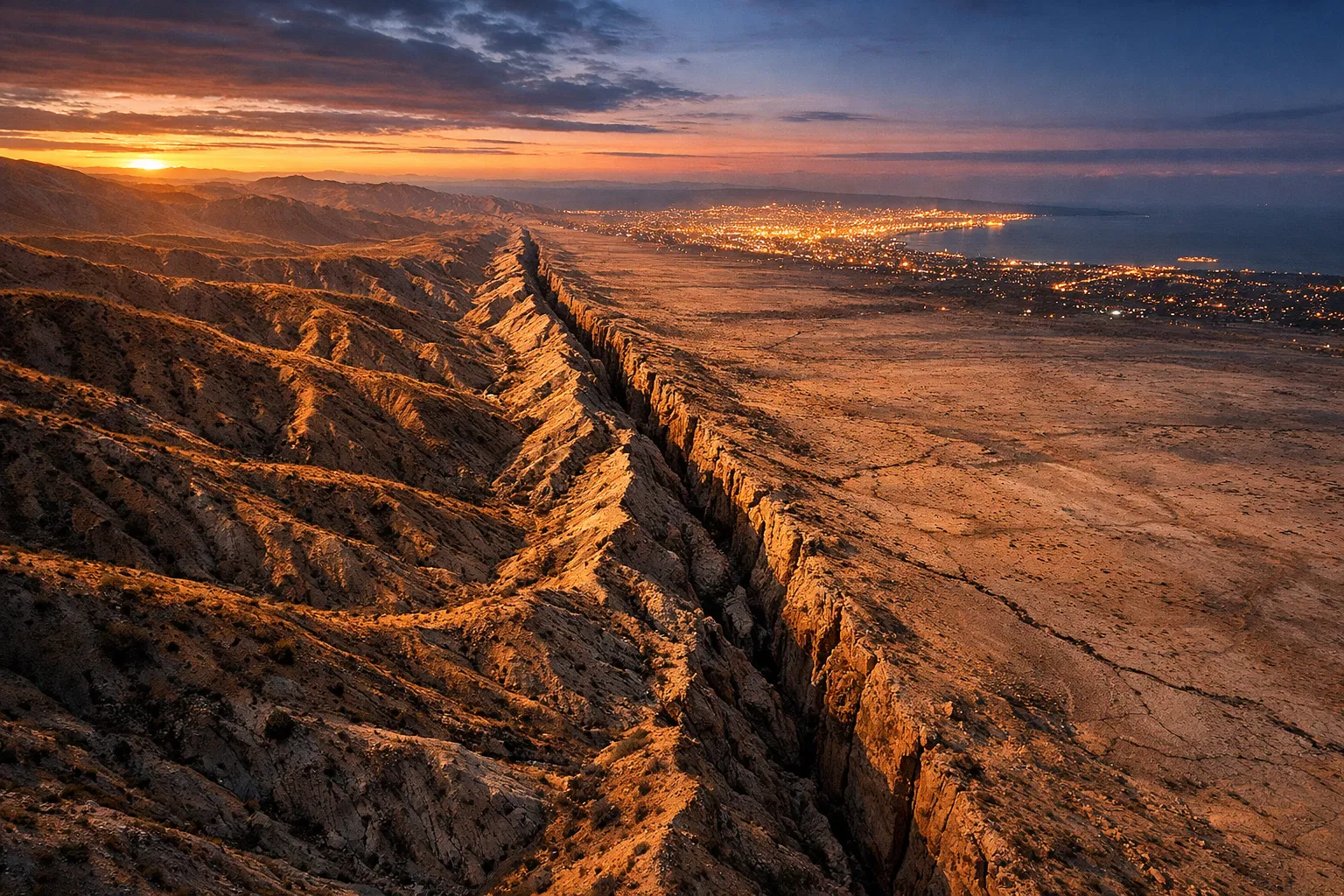
The ground beneath California never truly rests. Roads crack, hills slowly shift, and deep underground, two massive tectonic plates continue their endless grind against each other. The San Andreas Fault, often searched online as Zlom San Andreas, is not just a geological structure. It is one of the most studied fault systems on Earth and one of the few natural formations that has become part of popular culture itself.
For scientists, it represents a living laboratory of plate tectonics and seismic behavior. For residents of California, it is part of daily awareness. And for the rest of the world, it has become a symbol of nature’s unpredictable force.
What makes the San Andreas Fault fascinating is not simply the possibility of earthquakes. It is the strange relationship humans have developed with it. Millions of people continue building homes, businesses, highways, and entire cities directly beside a fault capable of producing catastrophic seismic events. That balance between danger and adaptation is what gives the fault its enduring legacy.
What Is the San Andreas Fault?
The San Andreas Fault is a massive transform fault that stretches roughly 800 miles across California. It forms the tectonic boundary between the Pacific Plate and the North American Plate.
Unlike subduction zones, where one tectonic plate dives beneath another, the San Andreas Fault operates through horizontal movement. The plates slide past each other side by side in what geologists call a right lateral strike slip fault.
v≈35 mm/year
That movement may sound small, but over millions of years it has dramatically reshaped California’s landscape. In some regions, the plates move around 20 to 35 millimeters per year. Oddly enough, that is roughly the speed at which human fingernails grow. Nature sometimes works with terrifying patience.
Key Characteristics of the Fault
| Feature | Details |
| Fault Type | Transform, right lateral strike slip |
| Length | About 800 miles or 1,300 kilometers |
| Location | California, United States |
| Plates Involved | Pacific Plate and North American Plate |
| Movement Rate | Approximately 20 to 35 mm per year |
| Geological Age | Estimated 15 to 30 million years old |
In fact, The San Andreas Fault remains one of the world’s most active and heavily monitored fault systems.
How the Fault Formed
Millions of years ago, the tectonic configuration of western North America looked very different. The Pacific Plate gradually began interacting with the North American Plate after the Farallon Plate started disappearing beneath the continent.
This interaction created a massive transform boundary. Over time, stress accumulated, rocks fractured, and the San Andreas Fault system emerged.
The fault is not a single clean crack running through California. That image appears often in movies, but geology is messier than Hollywood prefers. In reality, the system contains multiple branches, fractures, creeping sections, and locked segments that behave differently from one another.
Some areas release energy gradually through slow movement called creep. Other sections remain locked for decades or even centuries, quietly storing enormous tectonic stress until it finally releases during major earthquakes.
Why the San Andreas Fault Is So Famous
Part of the fault’s fame comes from science, but a large part comes from geography. The fault cuts through one of the most populated and economically important regions in the United States.
Major urban centers connected to the fault include:
- San Francisco
- Los Angeles
- San Bernardino
- San Diego metropolitan regions
- Silicon Valley corridors
That combination of dense population and seismic activity naturally attracts attention. A powerful earthquake here would not only affect California. It could disrupt global technology, shipping, finance, and transportation systems.
Then there is the cultural side. Disaster films, documentaries, survival shows, and even video games frequently reference the San Andreas Fault. The 2015 movie San Andreas helped push the fault back into mainstream conversation, even though many scientific details in the film were wildly exaggerated.
For example, the movie depicts massive tsunamis and near continent splitting destruction. Geologists from the California Geological Survey have repeatedly explained that California is not going to break off into the ocean. The fault’s movement is horizontal, not the dramatic vertical tearing often shown in fiction.
The Earthquakes That Changed History
The San Andreas Fault has produced some of the most significant earthquakes in North American history.
The 1906 San Francisco Earthquake
This remains the defining seismic event associated with the fault.
| Detail | Information |
| Year | 1906 |
| Estimated Magnitude | 7.8 |
| Death Toll | More than 3,000 |
| Major Impact | Fires, infrastructure collapse, mass destruction |
The earthquake ruptured hundreds of miles along the fault. Water pipes failed, fires spread uncontrollably, and entire neighborhoods were destroyed. The disaster became a turning point in modern seismology and urban planning.
Even today, researchers continue studying data from the event.
The 1989 Loma Prieta Earthquake
The 1989 earthquake struck during the World Series baseball championship, creating one of the first globally televised modern earthquake disasters.
| Detail | Information |
| Year | 1989 |
| Magnitude | 6.9 |
| Region | Northern California |
| Notable Damage | Bridge collapse, highway failure |
The collapse of sections of the Cypress Street Viaduct and Bay Bridge shocked the country. Yet the event also accelerated improvements in seismic building standards and emergency response systems.
Living Near the Fault, Fear and Adaptation
One of the most interesting things about California is how ordinary earthquake preparedness feels there.
People keep emergency water supplies in garages. Schools practice earthquake drills regularly. Older buildings undergo retrofitting. Smartphones now receive earthquake alerts seconds before shaking begins.
Those few seconds matter more than many people realize.
The ShakeAlert Earthquake Early Warning System developed by the U.S. Geological Survey can provide critical warnings before seismic waves arrive. Trains can slow down, surgeons can pause procedures, and people can move away from dangerous structures.
Common Earthquake Preparedness Measures
- Reinforced building construction
- Flexible bridge engineering
- Automatic gas shutoff systems
- Public emergency drills
- Household emergency kits
- Seismic monitoring networks
Preparedness has become woven into California’s identity. Residents understand risk, but life continues normally. That quiet acceptance says a lot about human adaptability.
The Science Behind Earthquake Prediction
One of the biggest misconceptions about earthquakes is that scientists can predict them precisely. They cannot.
Researchers can estimate probabilities and identify high risk regions, but no technology currently exists that can accurately predict the exact timing of a major earthquake.
Scientists instead focus on:
- Seismic wave monitoring
- GPS crust movement analysis
- Fault creep measurements
- Historical rupture patterns
- Stress accumulation modeling
The southern section of the San Andreas Fault especially concerns geologists because it has not experienced a major rupture since the 1857 Fort Tejon earthquake.
Many experts believe this section has accumulated significant tectonic strain.
The Southern California Earthquake Center continues extensive research into these risks using advanced simulations and fault mapping technologies.
The Psychological Fascination With the Fault
There is something strangely humbling about standing near the San Andreas Fault. In many locations, it looks almost ordinary. Dry hills, dusty roads, scattered grassland. Nothing dramatic.
Yet beneath that calm landscape lies immense stored energy.
Humans are naturally drawn to places that remind them how small they really are. Volcanoes, hurricanes, deep oceans, and fault lines all trigger that same mixture of fear and curiosity.
The San Andreas Fault represents uncertainty in physical form. You cannot see the stress building underground. You only know it exists.
That tension has made the fault both a scientific obsession and a cultural metaphor.
Lessons From the San Andreas Fault
The fault teaches lessons that extend far beyond geology.
What Humanity Has Learned
| Lesson | Meaning |
| Nature cannot be controlled | Earth processes operate independently of human plans |
| Preparation saves lives | Infrastructure and planning reduce disaster impacts |
| Science evolves through disasters | Major earthquakes improve understanding and technology |
| Communities become resilient | Recovery often strengthens social cooperation |
There is also a quieter lesson hidden within the fault’s story. Human civilization often assumes stability is permanent. The San Andreas Fault reminds us that the Earth itself is constantly moving, even when everything appears still.
A Fault Line That Continues Writing History
The San Andreas Fault is not merely a crack in the Earth. It is an active system shaping landscapes, cities, infrastructure, science, and culture simultaneously.
Every tremor adds another chapter to its history. Every scientific breakthrough improves humanity’s ability to coexist with it. And every generation living near the fault develops its own relationship with uncertainty.
That may be why the San Andreas Fault continues capturing global attention after more than a century of intense study. It is both deeply scientific and deeply human at the same time.
Beneath California’s highways and crowded cities, the plates continue moving slowly past one another. Quietly. Relentlessly.
And eventually, as geology always reminds us, pressure finds release.
FAQs About the San Andreas Fault
1. What is the San Andreas Fault and where is it located?
The San Andreas Fault is a major transform fault running through California, United States. It forms the boundary between the Pacific Plate and the North American Plate and stretches roughly 800 miles from the Salton Sea to northern California.
2. Why is the San Andreas Fault dangerous?
The fault is dangerous because tectonic stress builds over time between moving plates. When that stress suddenly releases, it creates earthquakes that can damage buildings, roads, bridges, utilities, and communication systems.
3. Could the San Andreas Fault produce a magnitude 10 earthquake?
No. Scientists consider a magnitude 10 earthquake on the San Andreas Fault extremely unlikely because the fault is not long enough to generate an event of that scale. Most realistic worst case estimates range around magnitude 7.8 to 8.3.
4. What was the deadliest earthquake connected to the San Andreas Fault?
The 1906 San Francisco earthquake remains the most devastating major event associated with the fault. It caused widespread fires and destruction, killing more than 3,000 people and reshaping earthquake science in the United States.
5. Can scientists predict when the next big earthquake will happen?
Scientists cannot predict the exact date or time of earthquakes. However, they can identify high risk regions, monitor tectonic stress, and estimate probabilities based on geological data and historical seismic activity.
