


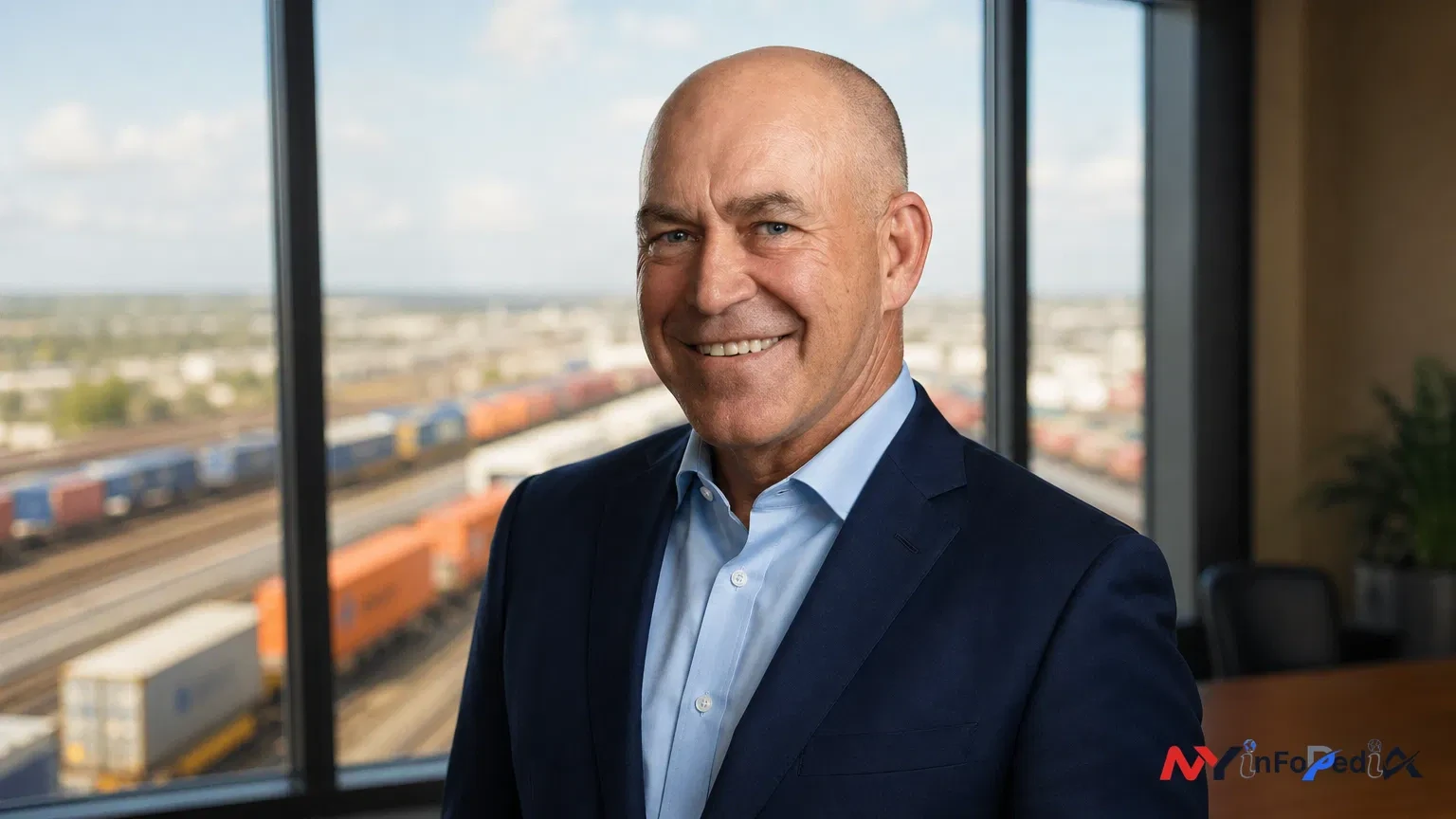
The story of Claude Edward Elkins Jr. does not follow the usual executive playbook. There is no sudden startup success or dramatic career pivot. Instead, it unfolds steadily, shaped by decades inside one of America’s most complex industries. His journey through Norfolk Southern Corporation offers a grounded look at how operational depth, patience, and strategic thinking still matter in modern leadership.
This article explores his career, leadership philosophy, financial trajectory, and broader impact on the freight rail industry, with practical insights for professionals aiming to build durable careers rather than quick wins.
Who Is Claude Edward Elkins Jr.?
Claude Edward Elkins Jr. is a senior American rail executive associated with Norfolk Southern Corporation, where he serves as Executive Vice President and Chief Commercial Officer. His career reflects a long-term progression through operational, technical, and commercial roles within the freight rail industry.
At a glance:
- Over three decades of experience in U.S. freight transportation
- Began career in an entry-level operational role (brakeman)
- Advanced through key positions across operations and management
- Currently leads commercial strategy, pricing, and customer relationships
- Known for combining operational depth with business decision-making
Rather than following a rapid or high-visibility career path, his progression is defined by consistency, system-level understanding, and gradual leadership development, an approach that aligns closely with the demands of large-scale infrastructure industries.
Early Foundations: Where Discipline Meets Opportunity
Growing Up in a Rail-Centric Region
Elkins was raised in Southwest Virginia, a region where railroads are not abstract infrastructure but part of daily life. Communities here are closely tied to freight movement, industrial logistics, and labor-intensive work. That environment tends to shape practical thinking early.
Instead of chasing prestige, many individuals from such regions focus on reliability, discipline, and consistency. These traits later show up clearly in Elkins’s leadership style.
Military Influence and Structured Thinking
Before entering the railroad industry, Elkins served in the United States Marine Corps. Military training introduces a framework that is hard to replicate elsewhere:
- Decision-making under pressure
- Chain-of-command clarity
- Accountability without ambiguity
- Execution discipline
These elements later translate well into industries like rail transportation, where safety, timing, and coordination are non-negotiable.
Education: A Non-Linear but Strategic Path
Elkins’s academic background is unconventional for a rail executive, yet it reveals something important about leadership development.
Academic Credentials
- Bachelor of Arts in English from the University of Virginia’s College at Wise
- MBA in Port and Maritime Economics from Old Dominion University
At first glance, an English degree may seem unrelated to logistics. In practice, it builds:
- Communication clarity
- Analytical reasoning
- Structured thinking
These are critical in executive roles where decisions must be explained, defended, and implemented across large organizations.
The MBA added technical depth in:
- Transportation economics
- Supply chain systems
- Maritime and intermodal logistics
This combination of soft and technical skills is often underestimated but highly effective.
Career Progression: Built From the Ground Up
Entry-Level Reality: The Brakeman Role
Elkins began his career in 1988 as a brakeman. This role is physically demanding and operationally intense. It involves:
- Coupling and uncoupling rail cars
- Monitoring train safety
- Working in unpredictable weather conditions
This is not a symbolic starting point. It creates a deep understanding of how rail systems actually function.
Operational Climb
His progression followed a logical sequence:
| Role | Key Learning |
| Conductor | Train coordination and scheduling |
| Locomotive Engineer | Technical control and safety systems |
| Relief Yardmaster | Network flow and yard efficiency |
Each role added a layer of operational awareness. By the time he moved into management, he already understood the system from inside out.
Transition to Commercial Leadership
Moving Beyond Operations
In the mid-2000s, Elkins transitioned into marketing and commercial roles. This shift is often where many operational professionals struggle. He managed it effectively by connecting two domains:
- Operational efficiency
- Customer value
Key Leadership Roles
- Group Vice President, Chemicals Marketing
- Vice President, Industrial Products
- Chief Marketing Officer
- Executive Vice President & Chief Commercial Officer
His current role places him at the center of revenue generation, pricing strategy, and customer relationships.
Leadership Style: Practical, Grounded, and Scalable
1. Operational Empathy
Unlike executives who rely solely on reports, Elkins understands frontline challenges. This creates:
- More realistic decision-making
- Better workforce trust
- Fewer strategic blind spots
2. Customer-Centric Strategy
Freight rail is no longer just about moving goods. It is about reliability, timing, and integration into supply chains.
His approach emphasizes:
- Long-term customer relationships
- Service consistency
- Scalable logistics solutions
3. Adaptability Without Disruption
His career shows gradual adaptation rather than abrupt change. This is often more sustainable in legacy industries.
Financial Perspective: Net Worth and Compensation
Estimates place Elkins’s net worth between $10 million and $20 million. His annual compensation typically includes:
- Base salary
- Performance bonuses
- Stock incentives
- Long-term equity plans
Why His Wealth Model Stands Out
Unlike tech executives who benefit from rapid valuation spikes, his financial growth is:
- Gradual
- Performance-linked
- Stability-driven
According to executive compensation frameworks discussed by organizations like the U.S. Securities and Exchange Commission, long-term equity incentives are designed to align leadership decisions with shareholder value. Elkins’s career reflects this model closely.
Norfolk Southern: The Institutional Context
A Legacy Railroad
Norfolk Southern Corporation is not just a company but part of U.S. industrial infrastructure. Its evolution includes:
- 19th-century rail expansion
- 20th-century consolidation
- 21st-century digital transformation
Current Industry Challenges
Modern freight rail faces:
- Supply chain volatility
- Environmental regulations
- Competition from trucking
- Infrastructure constraints
Elkins’s role involves balancing these pressures while maintaining profitability and service reliability.
Industry Impact: Beyond One Company
Driving Efficiency and Innovation
Under leadership like Elkins’s, rail companies have focused on:
- Intermodal expansion
- Digital freight tracking
- Network optimization
These changes are essential as global logistics becomes more interconnected.
Sustainability and Safety
Rail remains one of the most fuel-efficient freight modes. Industry reports from organizations like the Association of American Railroads highlight:
- Lower emissions compared to trucking
- Higher energy efficiency per ton-mile
Elkins’s leadership aligns with these long-term priorities.
Community and Board Involvement
Elkins extends his influence beyond corporate operations through roles in:
- Georgia Chamber of Commerce
- National Association of Manufacturers
- TTX Company
- East Lake Foundation
These roles reflect a broader perspective on economic development, workforce growth, and community impact.
Lessons for Professionals: What His Career Actually Teaches
- Depth Beats Speed
Rapid promotions are appealing, but deep expertise creates long-term leverage. - Start Anywhere, But Learn Everything
Entry-level roles are not limitations if treated as learning platforms. - Consistency Compounds
Thirty years in one organization can outperform frequent job switching when aligned with growth opportunities. - Communication Is a Leadership Skill
Technical expertise alone is not enough. Clear thinking and articulation matter. - Adapt Without Losing Core Identity
Elkins moved across roles but maintained a consistent approach to discipline and execution.
Subtle Reality: Not a Celebrity CEO
One interesting aspect of Elkins’s career is what it lacks. There is no high-profile personal branding, no media-heavy presence, and no dramatic public persona.
This reflects a broader truth about infrastructure industries. Leadership often happens quietly, but its impact is enormous.
Conclusion: A Career Built on Structure, Not Hype
Claude Edward Elkins Jr.’s journey offers a realistic blueprint for leadership in complex industries. It is not driven by shortcuts or visibility, but by accumulated knowledge, disciplined execution, and long-term alignment.
In a time when many careers are shaped by rapid transitions, his path feels almost countercultural. Yet it works, and it continues to deliver measurable results.
For professionals navigating uncertain career paths, there is something reassuring here. Progress does not need to be dramatic to be meaningful. Sometimes it just needs to be consistent.
Frequently Asked Questions (FAQs)
1. Who is Claude Edward Elkins Jr.?
Claude Edward Elkins Jr. is a senior American rail executive serving as Executive Vice President and Chief Commercial Officer at Norfolk Southern Corporation. He is known for rising from an entry-level railroad position to top leadership.
2. What is Ed Elkins’s net worth?
His estimated net worth ranges between $10 million and $20 million, primarily derived from long-term executive compensation, stock incentives, and performance-based earnings.
3. How did he start his career?
He began as a brakeman in 1988, a physically demanding operational role in the railroad industry, and gradually advanced through technical, managerial, and executive positions.
4. What is his educational background?
He holds a BA in English from the University of Virginia’s College at Wise and an MBA in Port and Maritime Economics from Old Dominion University.
5. Why is his career considered inspiring?
His journey demonstrates that long-term commitment, operational expertise, and disciplined growth can lead to executive success without relying on rapid job changes or high-profile visibility.
