


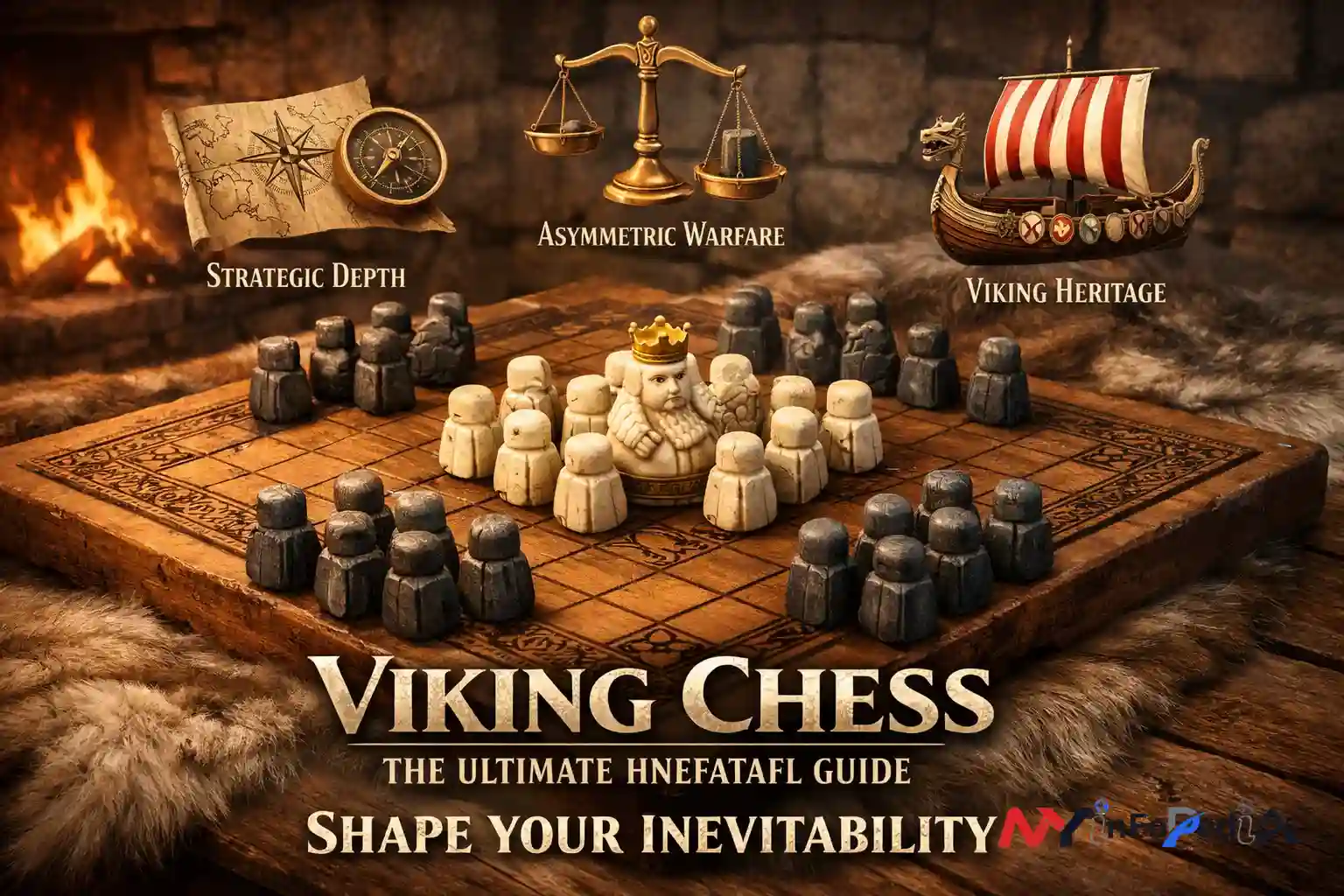
There is something oddly satisfying about games where the odds are not fair. Most board games aim for symmetry, equal armies, equal chances. Hnefatafl does the opposite. One side protects a king. The other hunts him down with superior numbers. It feels less like chess and more like a story unfolding on a board.
Well, Hnefatafl, also known as Viking Chess, looks simple when you first see it. A king in the center, attackers around the edges, a few pieces moving in straight lines. It feels manageable.
Then you play your first real game and realize something uncomfortable. The board is small, but the decisions are not. One weak move and the king slips out. Or worse, you slowly get boxed in without noticing when control was lost.
This is not a game of equal sides. It is a game of pressure, timing, and space collapse. That is exactly what makes it interesting.
What Is Hnefatafl and Why It Feels Different
Hnefatafl is an asymmetric strategy board game from Northern Europe. One side defends a king. The other hunts him.
That alone changes everything.
In chess, both players build threats. In Hnefatafl, one side tries to survive long enough to escape, while the other tries to prevent that escape from ever becoming possible.
The result is not just a different rule set. It is a different way of thinking.
- The defender plays for mobility and timing
- The attacker plays for control and containment
You are not just playing moves. You are shaping space.
Key Characteristics at a Glance
- Two players
- Unequal armies
- No randomness in most modern rules
- Short to medium game length
- Victory depends on position, not elimination
A More Concrete Look at the Rules
Most confusion for new players comes from how capture works. It is simple in theory but unintuitive in practice.
Movement Basics
- Pieces move any number of squares in straight lines
- Horizontal and vertical only
- No jumping over pieces
How Capture Actually Works
A piece is removed when it gets trapped between two enemy pieces on opposite sides.
Here is a clear scenario:
- A defender stands on a central square
- An attacker moves to its left side
- On the next turn, another attacker moves to its right
The defender is now sandwiched horizontally and removed immediately.
Think of the board as lanes. Capture happens when a lane is closed from both ends.
Special Squares You Must Understand
- Throne: the center square where the king starts. In many rules, it acts as a capturing aid
- Corners or edges: escape zones for the king
- Hostile squares: empty special squares that can assist in captures
Ignoring how these squares behave is one of the fastest ways to lose.
The Three Phases of Hnefatafl Strategy
Most players think in moves. Strong players think in phases.
Opening Phase: Structure and Spread
Attackers:
- Spread along edges but prioritize central entry lanes
- Occupy key files that lead directly to the throne
Defenders:
- Stay compact around the king
- Avoid creating early gaps between pieces
Critical detail:
If attackers fail to control central lanes early, the king can shift laterally from the center toward an edge. Once the king reaches a side corridor with two open squares ahead, attackers usually cannot rebuild a full containment in time.
Midgame: Compression and Spatial Control
This is where most games are decided.
Attackers:
- Tighten inward by occupying central lanes and blocking lateral king movement
- Build a staggered formation instead of a flat line, so gaps do not appear between pieces
- Control at least three adjacent approach squares on one side to deny safe access
Concrete anchor:
If attackers control three connected edge-adjacent squares on one flank, the king cannot safely approach that side without immediate risk of being boxed in.
Defenders:
- Create temporary escape corridors by forcing attackers to shift
- Trade pieces only when it opens space, not for material gain
Key idea:
Control in Hnefatafl is not about owning territory. It is about denying routes.
Endgame: Breakthrough or Containment
At this stage, the board simplifies and clarity increases.
Two outcomes dominate:
- The king finds a clear path of two or more open squares to an edge
- The attackers close all adjacent lanes and restrict movement to a shrinking box
Important nuance:
A king with two viable escape directions creates uncertainty attackers cannot fully cover. A king with only one predictable path becomes easy to trap.
Why Brute Force Fails in Hnefatafl
It is tempting for attackers to rush toward the center and try to trap the king early. This usually creates structural weakness.
Here is the issue:
- Advancing too quickly leaves empty lanes behind
- The defender uses one move to shift the king sideways
- That single shift opens a long escape corridor
Example:
An attacker moves aggressively into the center without side support. The defender moves the king one square toward a flank. A defender piece then blocks a counter-capture. Now a vertical lane is open. Attackers must retreat and rebuild, but tempo is lost.
By the time they recover, the king is already near the edge.
Brute force fails because it ignores space balance.
Advanced Tactical Patterns You Should Recognize
- The Corridor Escape
The king enters a narrow lane, defenders seal the sides, and attackers cannot close both ends in time. The escape becomes forced within a few moves. - The False Trap
Attackers appear to surround the king, but one side remains indirectly open. A defender sacrifices a piece, attackers take it, and the king slips through the newly opened line. - Edge Pressure Lock
Attackers push the king toward one side and occupy all adjacent approach squares. The king still has legal moves, but none lead to progress. Capture becomes inevitable.
Variants of Hnefatafl You Should Know
Different regions shaped the game differently. Choosing a variant matters.
Major Variants Overview
| Variant | Board Size | Key Difference |
| Tablut | 9×9 | Best preserved historical rules |
| Brandubh | 7×7 | Fast, tactical, high volatility |
| Tawlbwrdd | 11×11 | Welsh version with expanded armies |
| Alea Evangelii | 19×19 | Large, symbolic and complex |
| Copenhagen | 11×11 | Modern competitive standard |
Copenhagen Hnefatafl is widely used in tournaments because it balances attacker and defender dynamics more effectively than earlier reconstructions.
The History That Actually Matters
Hnefatafl is not just old. It reflects how people understood conflict.
In Norse sources like Orkneyinga Saga and Hervarar Saga, the game appears in royal and mythological settings. It is not described as casual entertainment, but as a display of intelligence.
One famous riddle attributed to Odin describes figures surrounding a lord without weapons. That is a direct metaphor for the game’s structure.
Archaeological finds support this status.
Boards and pieces have been discovered in:
- Ship burials in Norway
- Trading centers like Birka
- Religious sites such as Lindisfarne
Many sets were crafted from ivory, bone, or glass, often buried with elite individuals. This was a game associated with status, not just pastime.
Modern Hnefatafl and Where to Play Online
The modern version of Hnefatafl is active, but fragmented across platforms.
Where to Play
- Aage Nielsen’s Tafl server
Best for serious players. Supports Copenhagen rules, ranked matches, and tournaments. Competition level is noticeably higher. - Boardom
More casual environment. Faster games, simpler interface, good entry point for beginners. - Browser-based tafl apps
Useful for practice, but often lack strong opponents and consistent rule sets.
Rule Set Reality
Copenhagen rules dominate competitive play. If you want to improve seriously, learning this version is the most practical path.
Practical Strategy: How to Win More Games
For Attackers
- Control central lanes before advancing inward
- Maintain spacing so no two pieces leave a capture gap
- Track every potential escape path each turn
If your move does not reduce the king’s mobility, it is likely inefficient.
For Defenders
- Delay king movement until attackers commit structure
- Use defenders to create temporary openings
- Force attackers to reposition repeatedly
The king is strongest when hidden behind structure, not when exposed.
Common Beginner Mistakes
- Moving the king too early and becoming predictable
- Ignoring central control in the opening
- Clustering pieces, allowing easy captures
- Chasing captures instead of controlling space
Avoiding these alone can significantly improve performance.
Final Thoughts
Hnefatafl does not feel fair at first. One side has more pieces. The other has a fragile objective.
Then something shifts.
You stop reacting to moves and start recognizing patterns. The board begins to make sense. You see where pressure builds and where it breaks.
It stops being a game about survival or attack.
It becomes about shaping inevitability in a system that begins unbalanced. And the player who understands that is the one who eventually makes it feel that way.
FAQ: Common Questions About Hnefatafl
1.Is Hnefatafl harder than chess?
Not in rules, but in perception. Mistakes are less visible but more decisive, because they affect space rather than material.
2.What is the best strategy for attackers?
Focus on controlling central lanes and blocking lateral king movement. The goal is to remove options, not rush capture.
3.How to escape with the king in Hnefatafl?
Create two potential escape paths. Attackers can usually block one, but not both. The moment two lanes open, the king becomes difficult to stop.
4.How long does a game take?
Most games last between 5 to 20 minutes online, longer in slower formats.
