


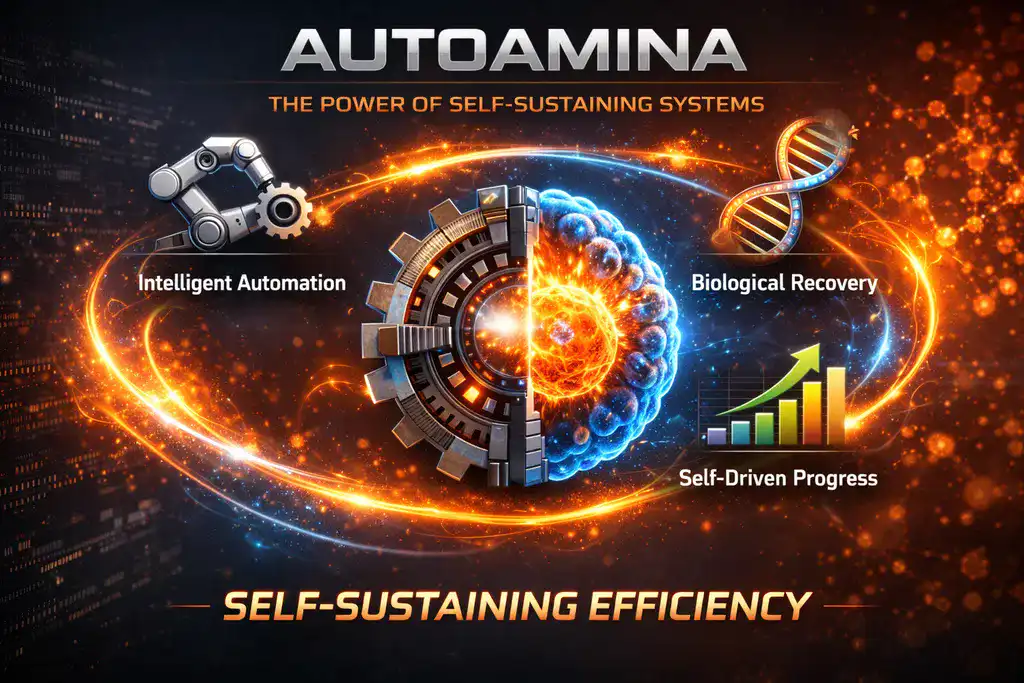
Autoamina is one of those rare concepts that seems to show up in completely different fields yet still carries a consistent underlying idea. In technology, it represents intelligent automation. In human performance, it describes biological recovery during sleep. In productivity and systems thinking, it reflects self-driven momentum.
At first, this overlap feels confusing. But look a little closer and a pattern appears. Autoamina always points to one thing. Systems that operate, improve, and sustain themselves with minimal external push.
This article breaks down Autoamina across its major interpretations, connects the dots between them, and explains why it is becoming a defining idea in modern innovation, performance, and business strategy.
What Is Autoamina?
Autoamina is best understood as a multi-dimensional concept rather than a single definition. It refers to the ability of a system, biological or technological, to sustain performance, adapt over time, and improve outcomes through internal mechanisms.
Core interpretation across domains
- In technology, Autoamina means intelligent automation powered by AI and machine learning
- In biology, it refers to internal recovery systems, especially muscle repair during sleep
- In productivity, it describes self-sustaining motivation and consistent progress
Despite the differences, the principle stays the same. Autoamina is about self-sustaining efficiency.
The Core Idea Behind Autoamina
At its foundation, Autoamina replaces dependency with autonomy.
Traditional systems rely heavily on external input. They need instructions, supervision, or constant correction. Autoamina-based systems reduce that dependency by building internal intelligence and adaptability.
Key characteristics
- Self-regulation without constant supervision
- Continuous improvement through feedback loops
- Ability to handle complexity and change
- Long-term efficiency rather than short-term output
This shift is subtle but powerful. It transforms systems from reactive to proactive.
Autoamina in Modern Technology
How Autoamina Powers Intelligent Automation
In the tech world, Autoamina is closely tied to advanced automation systems that go beyond simple rule-based execution.
Traditional automation follows fixed instructions. If something changes, the system breaks or needs manual updates.
Autoamina-driven systems behave differently.
They learn.
They adapt.
They optimize.
Core technologies involved
- Artificial intelligence for decision-making
- Machine learning for continuous improvement
- Natural language processing for human interaction
- Predictive analytics for forecasting outcomes
These technologies work together to create systems that do not just perform tasks but improve how those tasks are performed over time.
How Autoamina Systems Work
The workflow of an Autoamina system typically follows a loop.
| Stage | Function |
| Data Collection | Gathers information from multiple sources |
| Analysis | Identifies patterns and inefficiencies |
| Execution | Automates optimized workflows |
| Feedback | Learns from outcomes |
| Optimization | Refines future actions |
This cycle repeats continuously, making the system more efficient with each iteration.
Business Impact of Autoamina
Organizations adopting Autoamina are not just automating tasks. They are redesigning how work happens.
Key benefits
- Faster operations with reduced delays
- Lower operational costs due to automation
- Improved accuracy with fewer human errors
- Scalable systems that grow with demand
- Better decision-making using real-time data
There is also a human advantage. Employees spend less time on repetitive tasks and more time on strategic work.
That usually leads to better ideas and fewer headaches.
Real-World Applications of Autoamina
Autoamina is not theoretical. It is already active across industries.
Major use cases
Business operations
- Automating invoices, reporting, and internal workflows
- Reducing administrative workload
Healthcare
- Managing patient data and scheduling
- Assisting diagnostics through data analysis
Manufacturing
- Optimizing supply chains
- Controlling automated production systems
Customer service
- Intelligent chatbots handling complex queries
- Real-time customer behavior analysis
Transportation
- Autonomous vehicle systems
- Predictive maintenance for fleets
The common theme is clear. Efficiency improves without constant manual control.
Autoamina vs Traditional Automation
The difference between Autoamina and traditional automation is not incremental. It is structural.
| Feature | Traditional Automation | Autoamina |
| Flexibility | Low | High |
| Learning ability | None | Continuous |
| Maintenance | Manual updates | Self-optimizing |
| Decision-making | Rule-based | Data-driven |
| Scalability | Limited | High |
Traditional automation executes. Autoamina evolves.
Autoamina in Human Biology
Here is where things get interesting.
Autoamina is not only a technological concept. It also appears in human physiology, particularly in muscle recovery during sleep.
The biological side of Autoamina
During deep sleep and REM cycles, the body releases:
- Growth hormone
- Insulin-like growth factor
- Repair signaling compounds
These drive muscle repair, tissue recovery, and physical adaptation.
Why it matters
Training breaks muscle down. Recovery builds it back stronger.
Autoamina is essentially the internal recovery engine that makes physical progress possible.
Without it, effort does not convert into results.
Sleep and Autoamina Efficiency
Not all sleep contributes equally.
Critical factors
- Deep sleep quality
- REM cycles
- Hormonal balance
- Low cortisol levels
A disrupted sleep cycle reduces the effectiveness of this process significantly.
That is why athletes who sleep well often outperform those who simply train harder.
Autoamina and Productivity
Beyond biology and technology, Autoamina also explains something very human.
Why some people keep progressing even when motivation drops.
Autoamina as internal momentum
Most productivity systems rely on motivation. The problem is motivation fluctuates.
Autoamina does not depend on mood.
It depends on structure.
How it shows up in daily life
- Consistent habits that reduce decision fatigue
- Clear goals aligned with personal values
- Systems that make progress automatic
Writers who write daily, founders who keep building during slow phases, and professionals who maintain discipline all operate with some level of Autoamina.
Psychological Foundations of Autoamina
Autoamina aligns closely with well-studied psychological principles.
Core drivers
- Intrinsic motivation
- Habit formation
- Identity-based behavior
- Self-determination
When people feel ownership over their work and understand its purpose, sustained effort becomes natural rather than forced.
Challenges of Implementing Autoamina
Autoamina sounds ideal, but it is not friction-free.
Common obstacles
- High initial setup cost in technology systems
- Resistance to change within organizations
- Data privacy and security concerns
- Learning curve for users
On the human side, the challenges look different.
- Inconsistent habits
- Lack of clarity in goals
- Overreliance on short-term motivation
The solution in both cases is similar. Build systems gradually and focus on consistency.
The Future of Autoamina
Autoamina is moving toward becoming a standard rather than an exception.
What to expect
- Smarter automation systems that predict needs before they arise
- Integration with IoT creating connected intelligent environments
- Growth of self-optimizing business platforms
- Increased focus on human-system collaboration
In performance science, the focus on sleep and recovery will continue to grow as a key driver of results.
In productivity, systems thinking will replace motivation hacks.
How to Start Using Autoamina
You do not need advanced AI systems or elite athlete routines to apply Autoamina.
You can start small.
Practical starting points
For businesses
- Identify repetitive tasks and automate them first
- Use data to guide decisions instead of assumptions
For individuals
- Build simple daily routines
- Focus on consistency over intensity
- Improve sleep quality before increasing effort
For teams
- Encourage ownership rather than micromanagement
- Create systems instead of relying on reminders
A Simple Autoamina Framework
You can think of Autoamina as a loop.
- Input effort
- Observe results
- Learn from feedback
- Adjust system
- Repeat
Over time, the system becomes more efficient with less effort required.
Conclusion
Autoamina is not just a trend or a buzzword. It is a shift in how systems operate across technology, biology, and human behavior.
It replaces force with flow.
It replaces constant effort with structured consistency.
And perhaps most importantly, it shows that real progress is not about working harder all the time. It is about building systems that continue working even when you are not actively pushing them.
Whether you are running a business, improving performance, or simply trying to stay consistent in your daily life, understanding Autoamina gives you an advantage.
Not because it adds more work.
But because it makes the work you already do actually count.
