


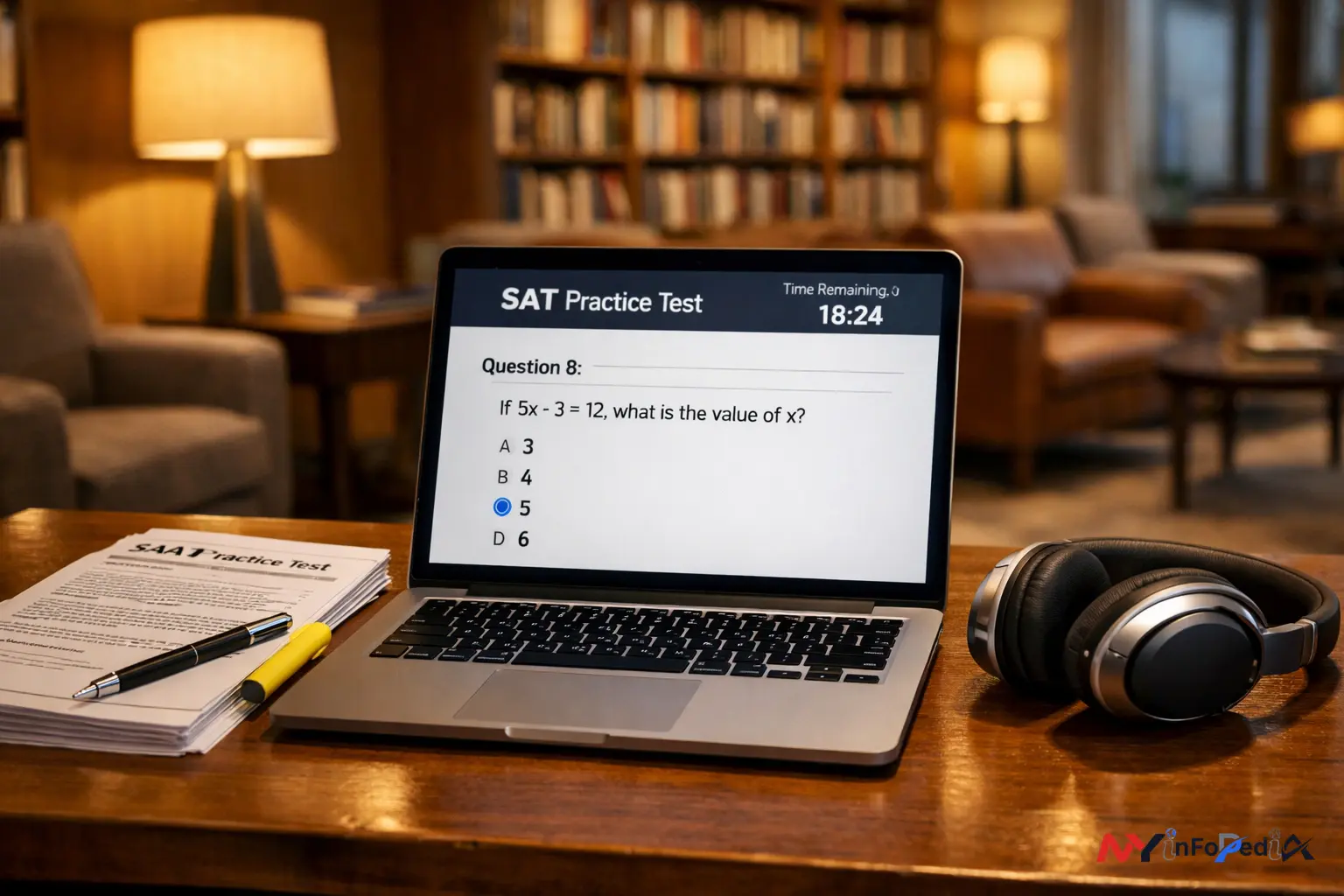
A Practical, In-Depth Look at Free Digital SAT Preparation
Preparing for the SAT used to mean thick prep books, expensive coaching classes, and a fair amount of guesswork. That landscape changed when Khan Academy partnered with College Board to create an official, free preparation system aligned with the modern SAT.
At first glance, it sounds almost too convenient. Free, official, and personalized. Naturally, students and parents wonder whether it actually works, how it compares to paid resources, and how to use it effectively without wasting time.
This guide breaks it down with clarity and practical insight. No hype, no shortcuts, just what matters.
What Is the SAT
The SAT is a standardized, computer-based exam used for college admissions, created by the College Board. It acts as a common benchmark so universities can compare students from different schools and education systems more fairly.
At its core, the SAT measures how well you can read, interpret, and apply concepts under timed conditions. It is less about memorization and more about practical reasoning.
SAT Structure at a Glance
| Section | What It Tests | Time |
| Reading and Writing | Comprehension, grammar, logical reasoning | ~64 minutes |
| Math | Algebra, data analysis, problem solving | ~70 minutes |
| Total | Combined score out of 1600 | ~2 hours 14 minutes |
The test is now digital and adaptive. Your performance in the first module influences the difficulty of the next, which allows the exam to assess your ability more precisely.
Scoring Basics
- Every section has a score from 200 to 800
- Total score ranges from 400 to 1600
- Scores are used alongside GPA, coursework, and other admission factors
What the SAT Really Evaluates
- Ability to analyze unfamiliar information
- Accuracy under time pressure
- Logical reasoning across subjects
- Consistency and focus during a timed exam
Most students take the SAT in their junior or senior year, often more than once to improve performance. A second attempt usually feels less intimidating simply because the format is no longer new.
In practical terms, the SAT is not just testing what you know. It is testing how effectively you can use what you know when it matters.
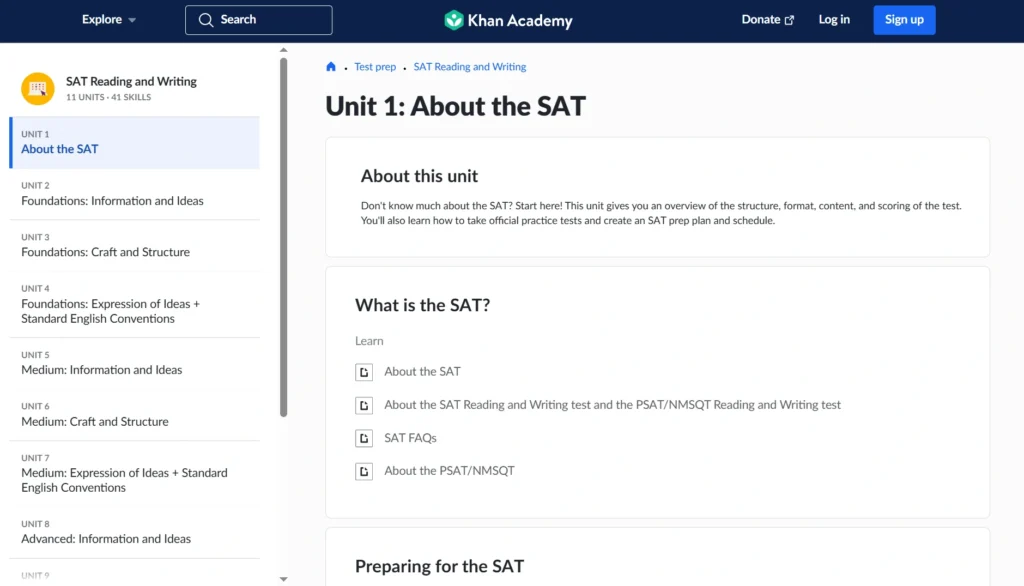
What Is Khan Academy SAT Prep
Khan Academy SAT Prep is a structured, digital learning system built in direct collaboration with the College Board. That partnership matters more than it might seem.
It means the content is not just similar to the SAT. It is designed to reflect how the test actually works, including:
- Question style and difficulty patterns
- Skill categories tested on the exam
- Adaptive learning structure
- Official practice tests
Unlike third-party platforms, which often approximate the exam, this system mirrors it more closely.
At its core, the platform combines three layers:
- Skill learning
- Practice application
- Performance feedback
That combination is what makes it effective when used properly.
Why Khan Academy SAT Prep Is Free
Both Khan Academy and College Board operate as non-profit organizations. Their collaboration was partly driven by a long-standing issue.
Students from higher-income backgrounds consistently perform better on standardized tests. Not necessarily because of higher ability, but because they can afford better preparation resources.
Free access attempts to reduce that gap.
The idea is simple. If every student has access to the same high-quality preparation, performance differences should reflect skill, not spending power.
In practice, this does not eliminate inequality entirely. Discipline, environment, and guidance still matter. But it removes a major barrier.
Core Features of Khan Academy SAT Prep
1. Diagnostic Assessment
The first step is a diagnostic quiz. It is short but strategically designed.
It evaluates performance across multiple skill areas, including:
- Reading comprehension
- Grammar and writing rules
- Algebra and problem-solving
- Data interpretation
The result is not just a score. It creates a skill profile.
Instead of studying everything blindly, you immediately know where you stand.
2. Personalized Practice Engine
This is where the platform becomes efficient.
Based on your diagnostic results, the system assigns targeted practice. If you struggle with scientific passages, you get more of those. If algebra is weak, it prioritizes algebra.
This reduces wasted effort.
Many students make the mistake of practicing what they already understand because it feels comfortable. This system quietly forces you toward weaker areas.
It is not always pleasant, but it is effective.
3. Video Lessons That Break Down Thinking
Khan Academy’s teaching style is different from traditional prep books.
Instead of giving answers, it walks through reasoning.
For example, a math question is not solved quickly. It is unpacked step by step:
- Why a method is chosen
- What the question is really asking
- Where students usually go wrong
Videos are typically short, often under 10 minutes, which makes them easier to fit into daily routines.
4. Massive Practice Question Bank
There are thousands of practice questions available.
Each question comes with:
- Immediate feedback
- Detailed explanations
- Clarification of incorrect options
This matters because learning happens in correction, not just repetition.
A student who reviews mistakes carefully often improves faster than someone who solves twice as many questions without reflection.
5. Full-Length Practice Tests
Khan Academy includes official full-length SAT practice tests.
These tests simulate:
- Real exam timing
- Question distribution
- Interface experience
Taking these tests regularly builds:
- Stamina
- Time management skills
- Familiarity with exam pressure
Many students underestimate stamina. Two hours of focused testing is mentally demanding, and practice is the only way to adapt.
What You Actually Prepare For with Khan Academy SAT Prep
The SAT is now digital and adaptive.
This means:
- The second module adjusts based on your first module performance
- Strong performance leads to harder questions
- Weak performance leads to easier ones
Khan Academy’s structure reflects this progression through leveled practice.
How to Use Khan Academy Effectively
Many students sign up, do a few questions, and stop. That approach rarely leads to meaningful improvement.
A more structured method works better.
Step 1: Start With a Diagnostic Test
Do not skip this.
It identifies your baseline and prevents random studying.
Step 2: Follow the Personalized Plan
Trust the system, at least initially.
It is designed to focus on your weakest areas first.
Step 3: Mix Learning With Practice
Avoid doing only one type of activity.
A balanced session looks like:
- Watch 1–2 concept videos
- Solve related practice questions
- Review mistakes carefully
Step 4: Use Short Daily Sessions
Consistency beats intensity.
Even 20–30 minutes daily is more effective than occasional long sessions.
Short sessions reduce burnout and improve retention.
Step 5: Take Weekly Practice Tests
Full tests serve a different purpose.
They help you:
- Measure progress
- Identify timing issues
- Adjust strategy
Do not treat them casually. Simulate real test conditions as much as possible.
Strengths of Khan Academy SAT Prep
Official Alignment
Because of its connection with the College Board, the content reflects the actual exam closely.
This reduces surprises on test day.
Personalization
The adaptive system makes study time efficient.
You focus where it matters instead of reviewing everything equally.
Depth of Explanation
The platform explains why answers are correct or incorrect.
This builds conceptual understanding, not just memorization.
Completely Free Access
No hidden costs, no limited features.
This makes it accessible to anyone with internet access.
Limitations You Should Know
No system is perfect, and ignoring limitations leads to poor planning.
Limited Strategy Training
Khan Academy focuses more on skills than advanced test strategies.
For example:
- Time-saving shortcuts
- Pattern recognition techniques
- Guessing strategies
These may require additional resources.
Requires Self-Discipline
There is no instructor pushing you.
Students who struggle with consistency may find it difficult to stay on track.
Can Feel Repetitive
Because of targeted practice, you may encounter similar question types frequently.
This is intentional, but it can feel monotonous.
Khan Academy vs Official SAT Study Guide
Both are linked to the College Board, but they serve different preferences.
| Feature | Khan Academy | Official Study Guide |
| Cost | Free | Paid |
| Format | Digital | Printed |
| Practice Questions | Extensive | Limited |
| Video Lessons | Yes | No |
| Convenience | Requires internet | Offline use |
The main advantage of the book is convenience. Some students prefer physical material.
But in terms of depth and interactivity, Khan Academy is stronger.
Real-World Example of Effectiveness
Students who actively use the platform often report noticeable score improvements.
A common pattern looks like this:
- Initial score around 1100–1200
- Focused practice over 6–8 weeks
- Gradual improvement in weak sections
- Final score increase of 100–200 points
The key factor is not the platform itself. It is how consistently and thoughtfully it is used.
Common Mistakes Students Make
Ignoring Weak Areas
Students tend to avoid difficult topics.
This slows progress significantly.
Skipping Review
Solving questions without reviewing mistakes limits learning.
The explanation section is where improvement happens.
Over-Reliance on Passive Learning
Watching videos alone is not enough.
Active practice is essential.
Not Simulating Real Tests
Practice tests done casually do not prepare you for actual exam conditions.
Is Khan Academy Enough on Its Own
For many students, yes.
It provides:
- Official-level practice
- Structured learning
- Performance tracking
However, some students benefit from adding:
- Strategy-focused guides
- Timed drills
- Peer discussion or tutoring
The decision depends on your learning style and discipline level.
Final Thoughts
Khan Academy SAT prep is one of the most accessible and practical tools available for standardized test preparation.
It removes financial barriers, provides official-level material, and adapts to individual performance. That combination is rare.
But the tool itself is only part of the equation.
Improvement comes from:
- Consistency
- Honest self-assessment
- Willingness to work on weaknesses
Used properly, it can be enough to significantly improve your score.
Used casually, it becomes just another unused resource.
The difference lies in how you approach it.
FAQs
1. Is Khan Academy enough to prep for the SAT?
For many students, yes, Khan Academy can be enough on its own.
Because it’s built with the College Board, its practice closely matches the actual SAT in structure and difficulty. That gives it an accuracy advantage over most third-party platforms.
However, effectiveness depends on usage. Students who follow the personalized plan, review mistakes, and take full-length tests seriously often see strong improvement. Those aiming for top-tier scores may still add strategy-focused resources, but disciplined use matters more than adding tools.
2. Is Official SAT Practice on Khan Academy as good as expensive test prep?
In terms of question quality and realism, often yes or better.
Khan Academy reflects the real SAT more closely, while many paid platforms rely on approximations. This makes its practice more relevant and less misleading.
Paid prep can still add value through structure, coaching, and accountability. But if you can stay consistent on your own, Khan Academy delivers comparable, sometimes superior, core preparation without the cost.
3. Is a 1350 a good SAT score?
Yes, a 1350 is a strong score.
It generally places you around the top 10% of test-takers, making you competitive for many universities. However, its value depends on your target schools. For highly selective colleges, it may be slightly below typical ranges.
The better question is whether it fits your goals. If it does, it’s sufficient. If not, there’s still room to improve.
4. Is 3 months enough to study for the SAT?
Yes, if used effectively.
A 3-month plan can lead to meaningful improvement with:
- consistent daily study
- targeted practice on weak areas
- weekly full-length tests
Many students improve by 100–200 points in this timeframe. The key is focused, active practice not passive learning or random question-solving.
5. Should I retake the SAT if I got a 1350?
Only if there’s a clear reason.
A 1350 is already competitive for many schools. Retake if:
- your target colleges expect higher scores
- your performance didn’t reflect your ability
- you have a better, more focused prep plan
Without a strategy, retaking rarely leads to significant gains. Improvement comes from fixing specific weaknesses, not just repeating the test.
