



Most online learning platforms fail for one simple reason: they feel like a random pile of videos. And if a platform feels like a random pile of videos, learners lose direction quickly. That is why the courses organization inside Khan Academy matters more than people usually realize.
Instead of being a loose collection of lessons, the platform is built around well-defined academic domains. Each domain follows a progression model, meaning learners move from basics to advanced topics in a structured path rather than jumping randomly.
This article breaks down those core courses in a practical, human-centered way. Not as a brochure, but as something closer to how students, parents, and self-learners actually experience it.
Why Courses Structure Matters in Online Learning
Before diving into courses, it helps to understand a simple idea. Learning online fails when content is unorganized.
Traditional classrooms solve this through curriculum sequencing. Khan Academy solves it digitally through mastery-based progression. You do not just “watch lessons,” you build skill layers step by step.
This structure is especially useful for:
- Students catching up after learning gaps
- Self-learners preparing for exams
- Teachers assigning structured digital practice
- Parents supporting home learning
Now let’s break down the actual subject ecosystem.
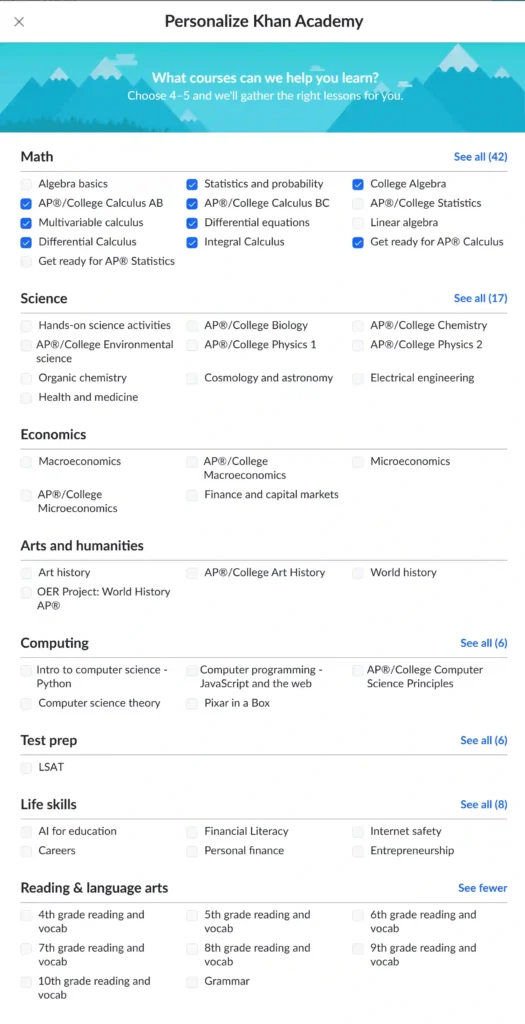
1. Mathematics: The Core Backbone of the Platform
If Khan Academy had a central nervous system, mathematics would be it.
A student struggling with fractions won’t move forward until they actually understand it
Mathematics is the most extensive and deeply structured course on the platform. It spans from early counting all the way to university-level calculus and linear algebra.
Major Math Categories
| Level | Topics Covered | Learning Focus |
| Early Math | Counting, shapes, basic addition | Foundation building |
| Elementary | Fractions, decimals, multiplication | Arithmetic fluency |
| Middle School | Ratios, algebra basics, geometry | Transition to abstraction |
| High School | Algebra 1 & 2, geometry, trigonometry | Structured problem solving |
| Advanced | Precalculus, calculus, statistics | Analytical reasoning |
| College Level | Linear algebra, differential equations | Higher mathematics |
What makes it effective
Math learning here is not linear video consumption. It is layered practice:
- A concept is introduced through short explanation
- Followed by guided examples
- Then adaptive exercises adjust difficulty automatically
A student struggling with fractions will not be pushed forward too early, which is where traditional systems often break.
A subtle strength people miss
Most platforms teach “answers.” This system focuses on “process.” That shift is why many learners report better long-term retention rather than short-term memorization.
2. Science: Connecting Concepts Instead of Memorizing Facts
Science on Khan Academy is built to connect ideas rather than isolate them.
It covers:
- Biology
- Chemistry
- Physics
- Earth and space science
- AP-level science courses
How science learning is structured
Instead of treating science as separate chapters, topics are built as systems.
For example:
- In biology, cell structure connects to genetics
- In physics, motion connects to energy and forces
- In chemistry, atomic structure connects to reactions
Course breakdown
| Science Area | Core Focus | Example Topics |
| Biology | Living systems | Cells, DNA, evolution |
| Chemistry | Matter and reactions | Periodic table, bonding |
| Physics | Motion and energy | Forces, waves, electricity |
| Earth Science | Planet systems | Climate, geology, astronomy |
Why this approach works
Science often fails when students memorize without context. Here, concepts are deliberately linked. That makes it easier to answer “why” instead of only “what.”
A practical example:
Instead of memorizing Ohm’s Law as a formula, learners see how current behaves in real circuits before applying equations.
3. English Language Arts (ELA): Reading, Writing, and Thinking
ELA is less about memorization and more about interpretation and expression.
It includes:
- Reading comprehension
- Grammar and sentence structure
- Vocabulary development
- Writing practice
How it is structured
Unlike math or science, ELA progression is less formula-based and more skill-refining.
| Skill Area | Focus |
| Reading | Understanding meaning and tone |
| Writing | Structuring arguments and essays |
| Grammar | Sentence clarity and correctness |
| Vocabulary | Context-based word usage |
A practical observation
Many learners underestimate ELA because it feels “natural.” But structured practice reveals gaps quickly, especially in writing clarity and inference-based reading questions.
This becomes especially important for standardized tests, where reading comprehension is often a score differentiator.
4. Computing and Computer Science: Learning Digital Logic
Computing has become one of the fastest-growing sections of the platform.
It includes:
- Programming fundamentals (Python, JavaScript)
- Algorithms and logic
- Computer science principles
- Web development basics
What learners actually do here
Instead of just watching coding explanations, learners:
- Write real code in browser-based environments
- Debug errors interactively
- Build logic step by step
Core progression model
| Stage | Focus |
| Beginner | Syntax and simple programs |
| Intermediate | Problem solving and logic building |
| Advanced | Algorithms and computational thinking |
Real-world relevance
This is not abstract theory. Even basic coding exercises resemble real programming tasks used in entry-level software development.
A simple example:
A loop problem in learning becomes the foundation for understanding automation in real systems.
5. Economics and Finance: Understanding Real-World Systems
Economics is one of the most practically relevant courses offered.
It includes:
- Microeconomics
- Macroeconomics
- Financial literacy
- Banking and markets
What learners study
| Area | Topics |
| Microeconomics | Supply, demand, pricing |
| Macroeconomics | GDP, inflation, policy |
| Finance | Budgeting, investing basics |
Why this matters beyond academics
This subject connects directly to daily life decisions:
- Why prices rise
- How loans work
- How inflation affects savings
- How markets respond to policy changes
It is one of the few areas where academic learning directly translates into personal financial awareness.
6. Arts and Humanities: Context Behind Human Culture
Arts and humanities cover the broader understanding of human history, creativity, and governance.
It includes:
- World history
- US history and civics
- Art history
- Philosophy basics
Structure of learning
Rather than memorizing timelines, learners explore:
- Cause and effect in historical events
- Cultural movements and their impact
- Evolution of governance systems
Example approach
Instead of just learning “World War II happened in 1939,” learners explore:
- Economic causes
- Political tensions
- Human consequences
This creates contextual understanding rather than isolated facts.
7. Test Preparation: Structured Exam Readiness
One of the most widely used features is standardized test preparation.
It includes:
- SAT
- MCAT
- LSAT
- AP exams
- Praxis Core
Why this section is different
Unlike general learning, test prep is highly structured around scoring improvement.
Example structure (SAT prep model)
- Diagnostic assessment
- Skill-based practice sets
- Timed mock tests
- Weakness tracking
Research shared by Khan Academy in partnership with the College Board has indicated that consistent practice is associated with measurable score improvement over time, especially when learners follow structured practice plans.
8. Life Skills: Learning Beyond Academics
Life skills content is often overlooked but highly practical.
It includes:
- Financial literacy
- College admissions guidance
- Career exploration
- Social and emotional learning
Why it matters
Academic success alone does not always translate into real-world readiness. This section fills that gap.
For example:
- How to manage personal budgets
- How to prepare for college applications
- How to understand workplace expectations
It is less about exams and more about decision-making in real life.
How All Courses Connect Into One Learning System
The real strength of Khan Academy is not individual subjects. It is how they interconnect.
A learner studying physics may rely on:
- Math for equations
- Computing for simulations
- Reading skills for comprehension
This creates a layered learning ecosystem rather than isolated courses.
Limitations You Should Honestly Be Aware Of
No system is perfect, and this one has clear boundaries:
- It cannot fully replace a real teacher or classroom interaction
- Advanced courses may still require external resources
- Some learners may need more teacher interaction for motivation
Even the platform itself has acknowledged that it is designed as a supplement, not a complete replacement for formal education.
Final Perspective
The courses structure inside Khan Academy is not random content organization. It is a carefully layered system designed to replicate academic progression in a digital environment.
Its strength lies in clarity, structure, and accessibility. Its limitation lies in the fact that it still depends on learner discipline.
But for structured self-learning, exam preparation, or academic support, it remains one of the most coherent free systems available today.
FAQs
1. What courses are offered on Khan Academy?
Khan Academy offers a wide range of courses including mathematics, science (biology, chemistry, physics), English language arts, computer science, economics, history, and test preparation. It also includes practical areas like financial literacy and life skills, making it a comprehensive learning platform.
2. Is Khan Academy only for math?
No, although math is its strongest and most structured subject, Khan Academy covers many other areas such as science, reading, writing, computing, and economics. However, non-math courses often work best as supplementary learning rather than full standalone curricula.
3. What age group is Khan Academy suitable for?
Khan Academy is designed for a wide age range, from early learners (pre-K) to college-level students. Younger children use guided programs like Khan Academy Kids, while older students can study advanced subjects such as calculus, economics, and test prep.
4. Is Khan Academy good for all subjects?
It is excellent for math and strong for structured practice-based subjects. For areas like history or literature, it is better used as a supplement rather than a complete replacement for traditional instruction, since depth and discussion may be limited.
5. What is the 50/30/20 rule explained by Khan Academy?
The 50/30/20 rule is a budgeting guideline where 50% of income goes to needs (rent, food), 30% to wants (entertainment, lifestyle), and 20% to savings or debt repayment. Khan Academy teaches this as a simple framework for managing personal finances effectively.
6. Does Khan Academy offer test preparation?
Yes, it provides structured test prep for exams like the SAT in partnership with the College Board, along with AP exams, LSAT, MCAT, and Praxis. These programs include diagnostic tests, practice questions, and progress tracking.
