


Most online learning platforms promise access, flexibility, and quality. Very few actually deliver all three without putting a price tag somewhere in the process. That is where Khan Academy stands apart.
At first glance, it looks like a simple website filled with videos and exercises. Spend a little time with it, and you start noticing something more deliberate. The structure is intentional. The teaching style is consistent. The mission is not hidden behind marketing language. It is direct, almost stubbornly so.
This article breaks down what Khan Academy really is, how it started, who built it, and why it remains one of the most widely used free learning platforms in the world.
What Is Khan Academy
Khan Academy is a nonprofit online education platform that provides free learning resources across a wide range of subjects. It serves students, teachers, and self-learners globally without charging subscription fees or locking content behind paywalls.
The platform includes:
- Short instructional videos
- Interactive exercises and quizzes
- Structured courses by grade and subject
- Progress tracking and learning dashboards
- Test preparation programs
Unlike many learning platforms that focus on content quantity, Khan Academy focuses on structured progression. A student does not just watch a video. They practice, get feedback, and move forward only after demonstrating understanding.
That approach is rooted in a concept called mastery learning. Instead of rushing through topics, learners build competence step by step.
Key Characteristics at a Glance
| Feature | Description |
| Cost | Completely free |
| Model | Nonprofit (501(c)(3)) |
| Content Type | Videos, exercises, quizzes |
| Subjects | Math, science, economics, humanities, computing |
| Audience | Students, teachers, lifelong learners |
| Access | Web and mobile apps |
The Mission Behind Khan Academy
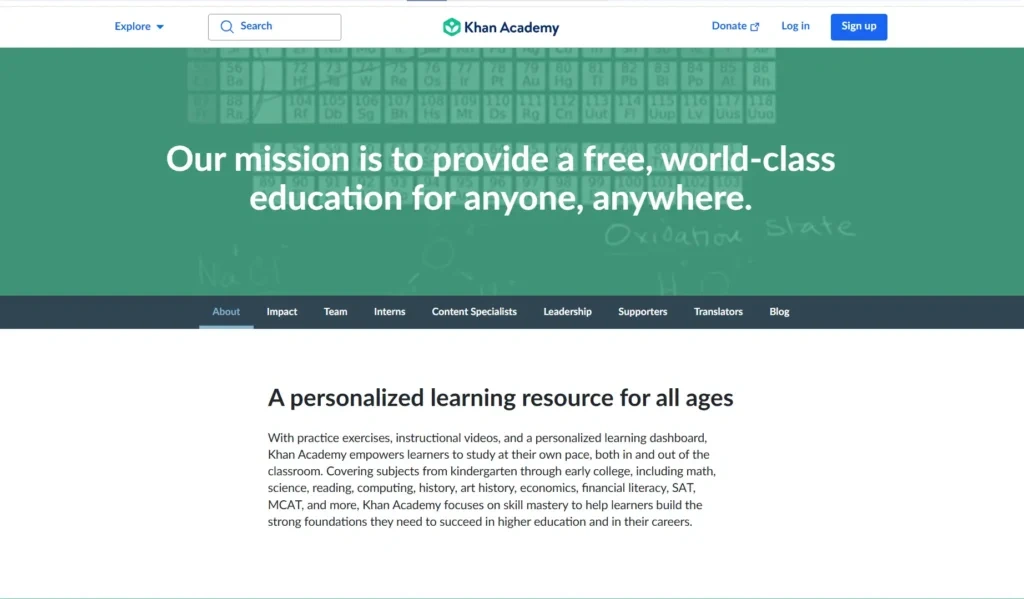
The mission is simple but unusually ambitious.
Provide a free, world class education for anyone, anywhere.
Khan Academy
This is not just a slogan. It shapes how the platform operates.
There are no premium tiers that unlock better content. There is no aggressive upselling. Funding comes primarily from donations and philanthropic support, including contributions from organizations like the Bill & Melinda Gates Foundation and companies such as Google.
That funding model matters. It allows the platform to prioritize accessibility over monetization. In practical terms, it means a student in a rural area with basic internet access can use the same learning materials as a student in a well-funded school system.
Who Created Khan Academy
Khan Academy was founded by Salman Khan, often referred to simply as Sal Khan.
His background is not what you might expect from someone who reshaped online education. He worked as a financial analyst and held degrees from institutions like MIT and Harvard. Teaching was not his original profession.
The project began in 2004 in a very ordinary way. Khan started tutoring his cousin remotely in mathematics. Instead of repeating explanations over the phone, he began recording short lessons and sharing them online.
Those early videos were basic. A digital blackboard, simple drawings, and a voice explaining concepts step by step. No studio production, no visual effects.
What happened next is what turned a personal tutoring effort into a global platform.
How Khan Academy Started
The turning point came when more students began using those videos than Khan could personally tutor. He uploaded the lessons to YouTube, making them publicly accessible.
A few key developments followed:
- Viewership grew beyond family and friends
- Media coverage increased visibility
- Demand for structured content became clear
- Khan transitioned from finance to full-time education work
In 2008, Khan Academy was formally established as a nonprofit organization.
One detail often overlooked is the simplicity of the early tools. Khan used basic drawing software and a tablet to simulate a classroom experience. That simplicity became part of the platform’s identity. Even today, many lessons retain that direct, distraction-free teaching style.
How Khan Academy Works
At its core, the platform combines three elements.
- Instructional Videos
These are short, focused explanations of specific topics. The style is conversational and deliberately paced. Concepts are broken down visually, often using a digital blackboard. - Practice Exercises
After watching a lesson, learners solve problems related to the concept. This is where passive learning turns into active engagement. - Progress Tracking
The system tracks performance and adapts recommendations based on strengths and weaknesses. Learners can see what they have mastered and where they need improvement.
This structure aligns with findings from educational research. A study published in the journal Computers & Education found that students using Khan Academy showed measurable improvements in performance, particularly in mathematics.
Subjects Covered on Khan Academy
Khan Academy covers a broad academic spectrum, but its strength lies in foundational subjects.
Core Areas
- Mathematics from basic arithmetic to calculus
- Science including physics, chemistry, and biology
- Economics and finance
- Computer science and programming
- Arts and humanities
- Test preparation
Mathematics remains the most developed area. The progression from basic concepts to advanced topics is particularly strong and widely used by both students and teachers.
Example Learning Path
A typical math progression might look like:
- Arithmetic basics
- Pre-algebra
- Algebra I
- Geometry
- Algebra II
- Precalculus
- Calculus
Each step builds directly on the previous one, reducing gaps in understanding.
Is Khan Academy Really Free
Yes, and this is where skepticism usually comes in.
Many platforms advertise free access but limit features or restrict advanced content. Khan Academy does not follow that model.
You can:
- Access all courses without payment
- Use practice exercises without limits
- Study without creating an account
- Track progress if you choose to sign up
The absence of hidden costs is not accidental. It is directly tied to its nonprofit structure and donor funding.
For example, in 2021, contributions from initiatives like the Musk Foundation supported ongoing development without shifting costs to users.
Creating an Account and Logging In
While you can browse content without signing in, creating an account unlocks key features.
How to Create a Khan Academy Account
- Visit the official website
- Click on the sign-up option
- Choose a method
- Google account
- Facebook account
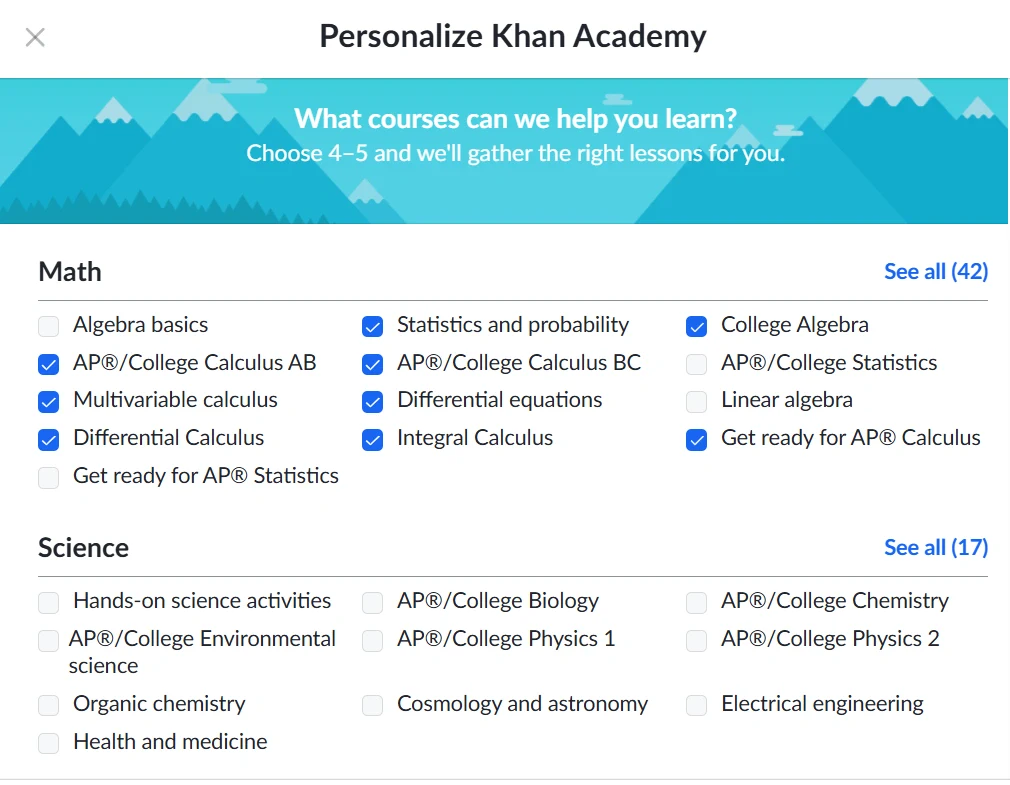
- Set your learning preferences
Benefits of Logging In
- Personalized learning dashboard
- Progress tracking
- Recommendations based on performance
- Ability to join classes
- Access to teacher assignments
The login system is simple, which lowers the barrier for new users. This is especially important for younger learners and those with limited technical experience.
Khan Academy for Teachers and Classrooms
Khan Academy is not just for individual learners. It has become a widely used classroom tool.
Teachers can:
- Create virtual classrooms
- Assign specific lessons or exercises
- Monitor student progress in real time
- Identify areas where students struggle
This aligns well with teaching models like the flipped classroom, where students learn concepts at home and use class time for discussion and problem-solving.
In practice, many schools use Khan Academy as a supplement rather than a replacement for traditional teaching.
Khan Academy and Test Preparation
One of the most impactful areas of the platform is test preparation.
Khan Academy partnered with the College Board to provide official SAT practice resources.
Why This Matters
- Practice questions are aligned with real exam formats
- Study plans adapt to individual performance
- Progress is measurable and trackable
According to official reports, students who spend at least 20 hours practicing on the platform see an average score improvement of around 115 points on the SAT.
That is a rare example of measurable impact in online education.
The Role of Technology and Innovation
Khan Academy has continued evolving, especially with the introduction of AI tools.
One notable development is Khanmigo, an AI-powered assistant designed to guide students through problems rather than simply providing answers.
This approach reflects a broader shift in educational technology. The goal is not automation, but guided learning.
Recent collaborations with companies like Google have also introduced AI-supported tools aimed at improving literacy and classroom interaction.
Strengths of Khan Academy
- Accessibility
Anyone with internet access can use it. This has made it particularly valuable in regions with limited educational resources. - Structured Learning
Courses are organized logically, reducing confusion and wasted time. - Practice-Based Approach
Learning is reinforced through exercises, not just passive content. - Consistent Teaching Style
The clear, conversational tone helps learners stay engaged.
Limitations to Be Aware Of
No platform is perfect, and Khan Academy has its limits.
- Limited Depth in Advanced Topics
While strong in fundamentals, it may not fully replace advanced university-level courses. - Minimal Human Interaction
There are no live instructors or real-time discussions. - Self-Motivation Required
Without deadlines or accountability, some learners struggle to stay consistent.
Interestingly, even Salman Khan has acknowledged that the platform is meant to support traditional education, not replace it.
Real-World Impact
Khan Academy has been used in diverse contexts:
- Schools integrating it into daily teaching
- Students preparing for standardized tests
- Adults revisiting foundational subjects
- Homeschooling families building structured curricula
In many developing regions, offline versions of the content have been distributed to expand access.
This real-world usage reinforces its credibility beyond theoretical benefits.
Final Thoughts
Khan Academy is not just a collection of educational videos. It represents a different approach to learning, one that prioritizes accessibility, clarity, and structured progress over monetization.
Its simplicity is part of its strength. There is no complex onboarding, no overwhelming interface, and no pressure to upgrade.
If you are looking for a place to build or rebuild academic fundamentals, it remains one of the most reliable starting points available today.
And perhaps the most surprising part is this. In a digital landscape filled with subscriptions and paywalls, it still costs nothing.
FAQs
1. Is Khan Academy 100% free?
Yes, Khan Academy is completely free to use. All lessons, exercises, and learning tools are available without subscription fees or paywalls. The platform is funded through donations and philanthropic support, allowing it to provide equal access to learners worldwide.
2. Who controls Khan Academy?
Khan Academy is a nonprofit organization, not a privately owned company. It is led by its founder Salman Khan and managed by a team of educators, engineers, and administrators. Strategic decisions are guided by its mission rather than profit.
3. What age is Khan Academy for?
Khan Academy is designed for a wide range of learners, from early elementary students to adults. It offers content for young children (through Khan Academy Kids), school-level subjects, and even advanced topics like calculus and economics, making it suitable for lifelong learning.
4. Is Khan Academy a full course platform?
Khan Academy provides structured courses across many subjects, especially in mathematics and science. However, it is primarily focused on foundational learning and concept mastery, and may not fully replace advanced university-level or professional certification programs.
5. Where can I learn coding for free?
You can learn coding for free on platforms like Khan Academy, which offers introductory courses in programming and computer science. For more advanced or specialized learning, platforms like Coursera and Udemy provide additional options, including both free and paid courses.
