


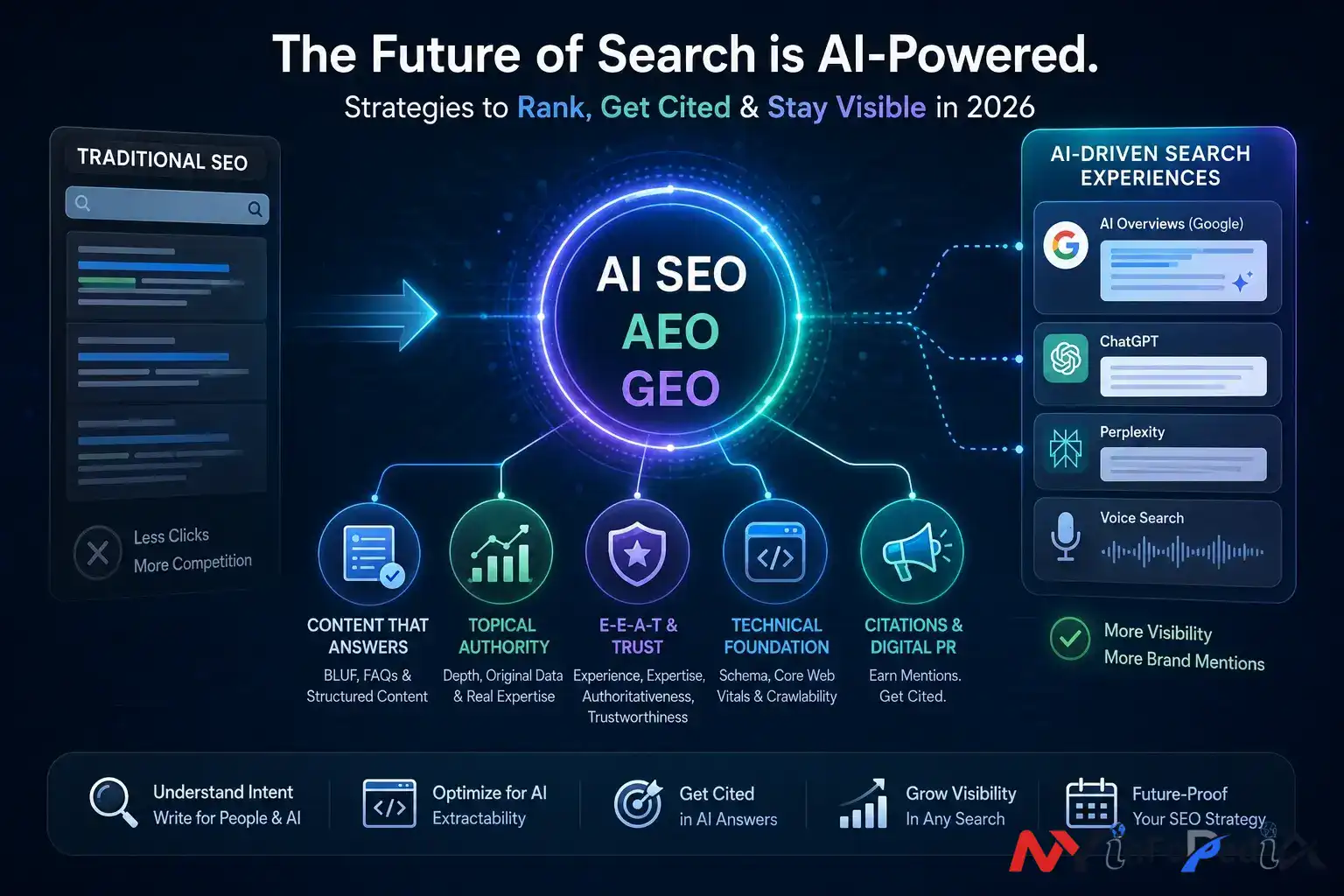
Search has changed more in the last two years than it did in the previous ten. That is not an exaggeration. If you have been watching your organic traffic plateau, your click-through rates quietly erode, or your carefully ranked pages suddenly disappear inside an AI-generated summary box, you already know something fundamental has shifted.
The question most marketers, content teams, and business owners are wrestling with right now is not whether AI has changed SEO. It clearly has. The real question is: what do you actually do about it?
This article breaks down what AI SEO, AEO, and GEO really mean in practice, which modern techniques are working in 2026, and what you should prioritize if you want your content to stay visible in an increasingly AI-mediated search environment.
What Is AI SEO and Why Does It Matter More Than Ever?
AI SEO is the practice of using artificial intelligence tools and techniques, including machine learning and natural language processing, to make your search optimization faster, smarter, and more aligned with how modern search engines actually work. It covers everything from keyword research and content optimization to technical audits and competitor analysis.
But here is where it gets interesting. The same AI technologies you are using to optimize your content are also the ones now sitting between your content and your audience. Google’s AI Overviews, ChatGPT Search, Perplexity, and Microsoft Copilot are all processing, summarizing, and delivering answers directly on the results page, without requiring users to click through to your website at all.
The AI SEO tools market is projected to grow from $1.2 billion in 2024 to $4.5 billion by 2033, with a compound annual growth rate of 15.2%. That kind of growth does not happen unless the underlying shift is real and lasting. AI-driven SEO campaigns have been shown to boost organic traffic by 45% and conversion rates by 38% for e-commerce websites, and 83% of SEO professionals at companies with more than 200 employees reported improved performance after adopting AI tools.
So yes, AI SEO is worth your attention. Not as a buzzword, but as a concrete shift in how you research, write, and structure content.
The Zero-Click Reality: Understanding What Has Actually Changed
Before diving into techniques, it helps to understand the environment you are optimizing for, because it looks quite different from 2022.
Nearly 60% of Google searches now end without a click, and AI Overviews appear in 89% of brand search results. Let that sit for a moment. More than half of everyone who searches for something on Google never visits a single website. Around 25.11% of all Google searches now return an AI Overview, a figure that has grown substantially from roughly 6.49% in January 2025 to around 25% by mid-year.
This is not uniformly bad news. The pattern is more nuanced. Impressions for pages that earn AI Overview citations rose roughly 49% in the year after AI Overviews launched. The asset being ranked has changed. You are no longer just competing for a blue link. You are competing to become the source that the AI cites.
Brands are 6.5 times more likely to be cited through third-party sources than through their own domains in AI-generated responses. That single statistic should reshape how you think about content distribution, digital PR, and off-site authority building.
According to a Goodfirms survey of over 100 digital marketing practitioners across more than 20 countries, 65% of marketers now cite AI-driven search changes as their single biggest challenge in 2026.
GEO: Generative Engine Optimization Explained
Generative Engine Optimization, commonly called GEO, is the discipline of structuring and writing content so that AI systems can extract, understand, and cite it in their generated responses. It goes by several names: some call it LLMO (Large Language Model Optimization), others AIO (AI Optimization), and the distinction between GEO and AEO is still somewhat fluid in practice. For now, think of GEO as the broader framework for appearing in AI-generated search outputs.
Traditional keyword stuffing is irrelevant here. AI systems do not reward density. They reward clarity, structure, factual accuracy, and uniqueness.
Here is what actually matters for GEO in 2026:
Structured content with logical headings.
AI extractors scan for clearly organized information. A wall of text is harder to cite than a well-structured answer with clean H2 and H3 headings, short paragraphs, and logical flow.
Unique data and original insights.
This is probably the most important factor most people overlook. AI systems are trained on existing content. According to known behavior patterns of models like Claude and GPT-5, they preferentially cite sources that contain information outside their training data, meaning original research, proprietary survey results, first-hand case studies, or specific statistics with a named source. Generic content that rephrases what is already everywhere gets absorbed and ignored.
E-E-A-T signals that are verifiable.
Experience, Expertise, Authoritativeness, and Trustworthiness (E-E-A-T) have been Google ranking factors for years, but they now function as citation filters for AI systems too. A clearly named author with a verifiable professional background, supported by credible external sources, is more likely to be cited than anonymous content with no accountability chain.
Semantic depth.
A single article that comprehensively covers a topic, including its related sub-questions and nuances, performs better in AI systems than ten shallow articles targeting one keyword each. Topical authority is not just an SEO strategy anymore. It is how AI systems decide what counts as a trustworthy source.
AEO: Answer Engine Optimization and How It Differs from Traditional SEO
Answer Engine Optimization is slightly more focused than GEO. Where GEO covers the full landscape of AI-driven search visibility, AEO specifically targets the formats that deliver direct answers to users: featured snippets, voice search results, Google AI Overviews, and responses from tools like ChatGPT, Perplexity, and Gemini.
The key distinction from traditional SEO is intent. Traditional SEO wants you to rank on page one and earn a click. AEO wants your content to be the answer, cited directly, even when no click ever happens.
| Dimension | Traditional SEO | AEO |
| Primary goal | Drive clicks to website | Secure citations inside AI-generated answers |
| Format focus | Keywords, meta titles, backlinks | FAQs, structured definitions, BLUF answers |
| Visibility metric | SERP position | AI citation frequency, featured snippet wins |
| Content style | Long-form keyword-rich pages | Concise, structured, entity-rich writing |
| Voice search | Secondary consideration | Core design requirement |
| Click dependency | High | Low, sometimes zero |
How to Actually Implement AEO
Use the BLUF approach.
Bottom Line Up Front. Answer the question directly in the first one or two sentences of a section, then expand with supporting detail below. This mirrors how AI systems and voice assistants extract answers, and it is also just good writing.
Write entity-rich content.
Instead of vague references to “a popular platform” or “leading companies,” name them specifically: Google, Perplexity, Semrush, BrightEdge. AI systems need concrete entities to build context. Vague language gets skipped.
Build out FAQ sections with real questions.
Not imaginary questions you made up to stuff keywords, but actual queries people are searching for. Tools like Semrush, Ahrefs, and the People Also Ask section in Google are all useful for finding these. The FAQ format is one of the cleanest structures for AI extraction.
Use schema markup.
Adding structured data, particularly FAQ schema, HowTo schema, and Article schema, makes your content significantly easier for search engines and AI systems to parse. This is one of the few genuinely technical SEO moves that carries direct AEO benefits.
Modern AI SEO Techniques That Are Actually Working in 2026
1. Keyword Research With Intent Mapping
AI keyword tools like the ones built into Semrush, Ahrefs, and Nightwatch have moved well beyond search volume and difficulty scores. They now cluster keywords by intent, which is far more useful than a raw list of terms. When you understand that “best AI SEO tools” carries commercial investigation intent while “what is AI SEO” carries informational intent, you write very different content for each, even if both contain the same primary keyword.
The shift worth noting here: by October 2025, AI Overviews had expanded from appearing almost exclusively on informational queries (91.3% in early 2025) to covering 57.1% informational and a significant share of commercial and buying-intent queries. That means even your transactional pages need to be written with AEO principles in mind, not just your blog content.
2. Content Depth Over Content Volume
This one keeps coming up because it keeps being ignored. The websites being punished in 2026 are not the small ones. Some of the biggest content platforms have collapsed under the weight of their own AI-scaled output. HubSpot, once considered untouchable in the marketing SERPs, has seen dramatic visibility declines. The pattern is consistent: high-volume, low-depth content is being de-ranked across industries.
What works instead is content that offers something that cannot be generated by AI alone: first-hand experience, original data, specific professional judgment, and nuanced perspective built from real domain knowledge.
3. Multi-Surface Visibility Strategy
Monthly AI assistant sessions are now 56% the size of Google search sessions globally, and search-related prompting in AI tools is 28% the size of traditional search worldwide. That means a meaningful portion of your potential audience is not on Google at all when they ask a question relevant to your content.
A modern SEO strategy in 2026 is not just about Google. It includes presence on Reddit (which experienced over 600% organic traffic growth since 2023 after its content deal with Google), LinkedIn for professional queries, YouTube for how-to and explainer searches, and Quora for question-based discovery. Brands are more likely to be cited in AI responses through third-party sources than their own domains, which means your off-site presence is now as important as your on-site content.
4. Technical SEO for AI Crawlability
AI extractors and search bots behave differently from traditional crawlers. A few technical priorities specific to AI-era SEO:
- Clean, fast HTML with logical heading hierarchy
- Schema markup for every major content type on the site
- Core Web Vitals scores that pass without exceptions (LCP under 2.5 seconds, INP under 200ms, CLS under 0.1)
- No duplicate content, which AI systems identify quickly and penalize by diluting your authority signals
- Accessible, well-structured internal linking that helps AI understand your topical coverage
5. Digital PR as an AI Citation Strategy
Brands are 6.5 times more likely to be cited in AI responses through third-party sources than through their own domains. This is arguably the most underappreciated insight in AI SEO right now. If you want ChatGPT or Perplexity to mention your brand when a user asks a relevant question, the path there runs through authoritative third-party mentions: industry publications, credible news sources, expert roundups, and genuine PR coverage. Not paid placements. Not low-quality guest posts. Actual citations in sources that AI systems trust.
What Is Changing in How Google Evaluates Content
Google’s March 2026 Core and Spam Updates were significant. Lily Ray’s analysis of the fallout showed multiple established SaaS brands losing between 29% and 49% of their organic visibility, with the common thread being blogs filled with self-promotional “best of” listicles, often scaled rapidly using AI. The update was not subtle: Google de-ranked content that appeared designed to game LLM citations rather than serve users.
Google’s own documentation is clear: content is evaluated on value, regardless of how it was produced. But in practice, generic AI content, even if technically grammatically correct and keyword-optimized, tends to fail the uniqueness and depth tests that modern ranking algorithms prioritize.
A Practical Priority Framework for 2026
If you are trying to figure out where to start, here is a sensible order of operations:
- Audit your existing content for depth and uniqueness. Pages that are thin, generic, or structurally identical to dozens of competitors are the most vulnerable. Refresh them with original data, first-person expertise, or updated examples before creating new content.
- Add BLUF answers and FAQ sections to your highest-traffic informational pages. This is the fastest AEO implementation win and requires no technical changes.
- Implement or review your schema markup. FAQ schema, Article schema, and HowTo schema should cover your primary content types. Tools like AIOSEO for WordPress make this approachable without a developer.
- Build a content calendar around topical authority, not keyword lists. One comprehensive piece that answers a topic from multiple angles and covers related sub-questions will outperform five shallow articles targeting individual keywords.
- Invest in digital PR and authoritative third-party mentions. This is now a direct citation strategy, not just a brand awareness play.
- Track AI visibility, not just rank position. Tools like Semrush and BrightEdge now offer AI Overview tracking. If your content is being cited in AI responses, that is a meaningful performance signal even when click-through rates are declining.
FAQs: Real Questions, Direct Answers
Q1. Is SEO dead in 2026?
No, but it has fundamentally changed what it means to be visible. Traditional blue-link SEO is declining in direct traffic terms, but the underlying practice of making content findable, trustworthy, and structurally clear is more important than ever. The audience is still searching. The delivery mechanism is what has changed. SEO professionals who understand GEO and AEO principles are among the most in-demand marketing specialists right now.
Q2. What is the difference between SEO, AEO, and GEO?
Traditional SEO optimizes content to rank in search engine results pages and earn clicks. AEO (Answer Engine Optimization) focuses specifically on getting your content cited as a direct answer in AI-generated responses, featured snippets, and voice search outputs. GEO (Generative Engine Optimization) is the broader discipline of optimizing for AI systems like ChatGPT, Perplexity, and Google AI Mode, where the goal is not a ranking position but citation within a generated answer. In practice, all three overlap significantly and should be applied together.
Q3. Will AI replace SEO professionals?
Unlikely, at least not the good ones. AI tools handle the mechanical work well: keyword clustering, content audits, meta tag generation, and pattern recognition across large datasets. What AI cannot replicate is original expertise, genuine first-hand experience, strategic judgment about what a specific business actually needs, and the kind of nuanced content that passes the E-E-A-T filter. The role is evolving, not disappearing. SEO professionals who adopt AI tools while maintaining human oversight and strategic depth will have a significant advantage.
Q4. How do you get your content cited in Google AI Overviews?
There is no guaranteed method, but several factors consistently appear in research. Structured content with clear logical headings, schema markup, BLUF-style direct answers, original data or statistics with named sources, and strong E-E-A-T signals all increase citation probability. Being cited on authoritative third-party platforms also matters considerably, since AI systems often draw citations from sources that already carry trust signals. Publishing frequently and building topical authority around a specific domain also helps.
Q5. What is the most important SEO technique for 2026?
If you had to pick one: build genuine topical authority through depth and originality. Not because it is new, but because it is the one quality that neither AI content generation nor zero-click search can undermine. AI-generated answers will always need authoritative sources to cite. If your content is the most credible, most specific, and most structurally clear resource on a topic, it gets cited. That is what visibility looks like in 2026.
