


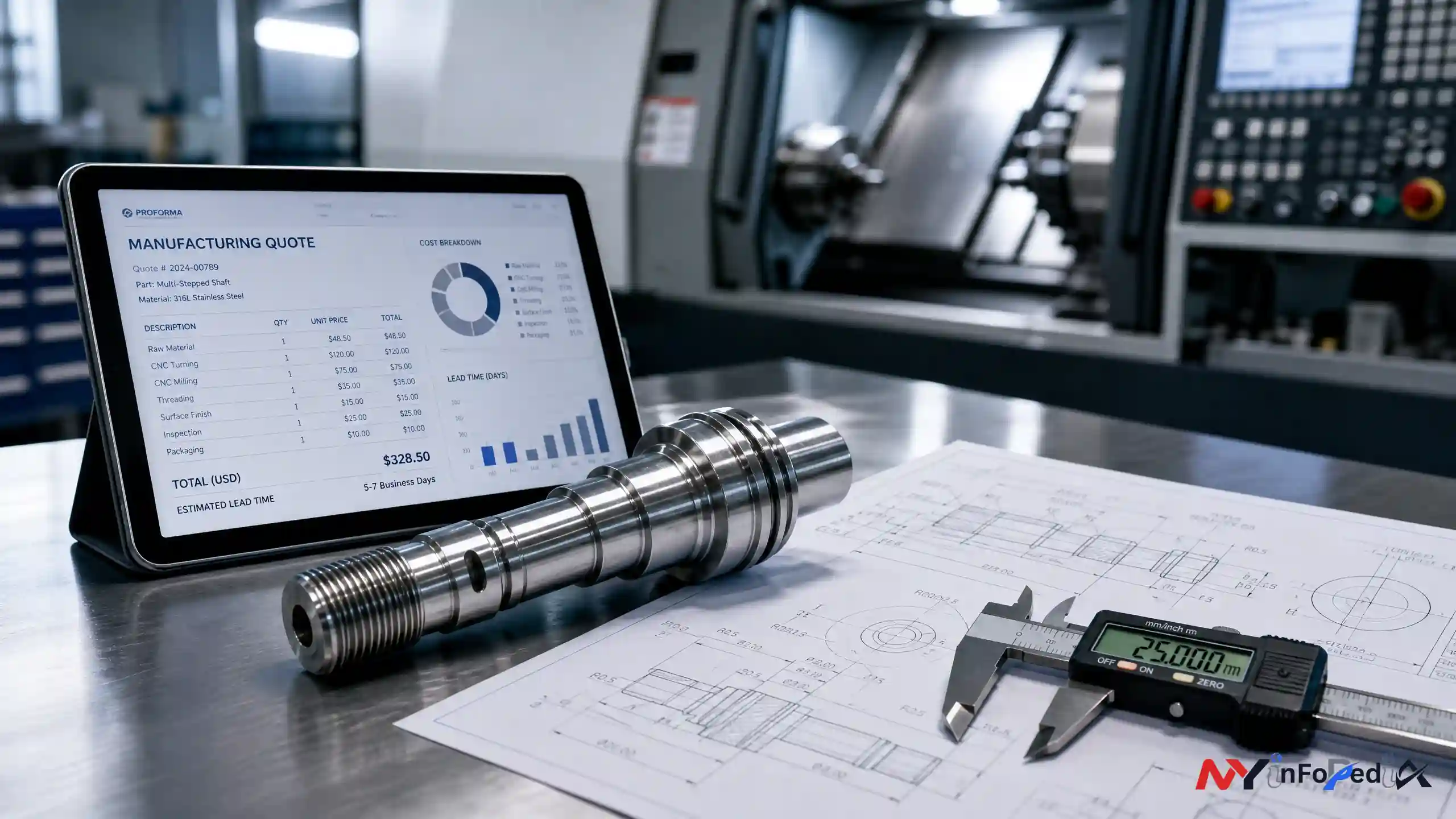
Modern manufacturing moves fast, but CNC turning quotes can still feel strangely mysterious. One shop sends a price that seems surprisingly low. Another sends a quote three times higher for what looks like the same part. Then there are setup fees, tooling charges, tolerances, lead times, inspection reports, and material markups quietly hiding in the fine print like tiny mechanical gremlins.
For buyers, engineers, startups, and procurement teams, understanding CNC turning quotes is not just about finding the cheapest supplier. It is about balancing cost, precision, reliability, and production efficiency without accidentally paying aerospace-level pricing for a simple aluminum spacer.
This guide breaks down how CNC turning quotes actually work, what affects pricing, how manufacturers calculate costs, and how to reduce expenses without sacrificing quality.
What Is a CNC Turning Quote?
A CNC turning quote is a manufacturing cost estimate for producing cylindrical or rotational components using CNC lathes or turning centers. The quote typically includes machining time, material costs, tooling expenses, setup charges, finishing operations, and delivery timelines.
In simple terms, the quote answers one core question:
How much will it cost to turn your CAD design into a finished physical part?
Most CNC turning providers generate quotes after reviewing:
- CAD files
- Technical drawings
- Material specifications
- Surface finish requirements
- Tolerances
- Production quantities
- Lead time expectations
Shops using automated quoting systems can often provide instant pricing within minutes. More complex parts may require manual engineering review before pricing is finalized.
How CNC Turning Works
Before understanding pricing, it helps to know what the process actually involves.
CNC turning is a subtractive manufacturing method where a rotating workpiece is cut by a stationary single-point cutting tool. The process is primarily used to create:
- Shafts
- Bushings
- Pins
- Couplings
- Sleeves
- Threaded components
- Cylindrical housings
The machine rotates the raw material while the cutting tool removes material layer by layer until the final geometry is achieved.
A surprising number of industries rely heavily on CNC turned parts, including:
- Automotive
- Aerospace
- Medical devices
- Oil and gas
- Robotics
- Electronics
- Industrial automation
Even everyday objects quietly depend on CNC turning. That stainless steel shower fitting in your bathroom probably had a brief but meaningful relationship with a CNC lathe at some point.
Main Components Inside a CNC Turning Quote
Not all quotes are structured the same way, but most include several common cost categories.
Machine Time
Machine time is usually the largest cost factor.
Manufacturers calculate how long the CNC lathe will take to complete the part and multiply that by the hourly machining rate.
Typical CNC turning machine rates range between:
| Machine Type | Average Hourly Cost |
| Standard CNC Lathe | $65 to $120/hr |
| Multi-Axis Turning Center | $120 to $250/hr |
| Swiss-Type CNC Machine | $100 to $200/hr |
Complex geometries, live tooling operations, and tight tolerances increase machining time significantly.
Setup Fees
Setup costs cover:
- Programming
- Tool setup
- Fixture alignment
- Machine calibration
- First article inspection
These costs are mostly fixed regardless of quantity.
That is why low-volume orders often seem expensive. A shop still spends hours preparing the machine even if you only order five parts.
Material Costs
Raw material pricing depends on:
- Material type
- Material grade
- Diameter
- Availability
- Market fluctuations
Common CNC turning materials include:
| Material | Machinability | Relative Cost |
| Aluminum 6061 | Excellent | Low |
| Brass | Excellent | Medium |
| Stainless Steel | Moderate | Medium-High |
| Titanium | Difficult | High |
| Carbon Steel | Good | Medium |
Harder materials increase tooling wear and cycle time, which raises costs further.
Tooling and Consumables
Turning tools wear down over time. Carbide inserts, drills, boring bars, and threading tools all contribute to manufacturing costs.
Some suppliers include tooling costs inside hourly rates. Others list them separately.
This is why two quotes with different structures can sometimes have nearly identical actual production costs.
Secondary Operations
Post-processing can add substantial costs depending on the part requirements.
Common secondary services include:
- Anodizing
- Powder coating
- Electropolishing
- Heat treatment
- Sand blasting
- Laser engraving
- Thread tapping
- Inspection reports
A part that costs $20 to machine can easily become a $45 component after specialty finishing.
Factors That Increase CNC Turning Costs
Tight Tolerances
One of the biggest pricing drivers is dimensional tolerance.
A tolerance of ±0.005 mm demands far more precision than ±0.05 mm. That extra precision means:
- Slower cutting speeds
- Additional inspections
- More stable setups
- Higher rejection risks
Many engineers unknowingly over-specify tolerances on non-critical features. Manufacturers notice this immediately.
Relaxing unnecessary tolerances can reduce costs dramatically.
Complex Geometry
Simple cylindrical parts are relatively inexpensive.
Costs rise quickly when parts include:
- Deep grooves
- Internal splines
- Off-center features
- Live tooling operations
- Multi-axis machining
- Tiny drilled holes
- Thin walls
Complexity increases machine time, programming effort, and tool changes.
Small Production Runs
Prototype pricing is usually much higher per part than mass production pricing.
Here is why:
| Quantity | Approximate Setup Cost Per Part |
| 10 Parts | $15 |
| 50 Parts | $3 |
| 500 Parts | Under $1 |
The setup burden gets distributed across more units as volume increases.
Expedited Lead Times
Fast delivery almost always costs more.
Rush orders may require:
- Overtime shifts
- Priority scheduling
- Dedicated machine allocation
- Faster shipping methods
If your project timeline allows flexibility, standard lead times usually provide better pricing.
Instant CNC Turning Quotes vs Manual Engineering Quotes
Online CNC platforms have changed the quoting process dramatically.
Companies now offer instant quoting by analyzing uploaded CAD files automatically.
Popular providers include:
- RapidDirect
- Protolabs
- PCBWay
- eMachineShop
- Xometry
These systems work well for standard parts, but highly complex projects often still require human engineering review.
Automated systems can estimate:
- Material usage
- Machining time
- Tool accessibility
- Manufacturability risks
Still, experienced machinists often catch practical production issues software may overlook.
And machinists definitely have opinions. Strong opinions. Sometimes about feed rates. Sometimes about whoever designed a 0.2 mm wall thickness.
How to Reduce CNC Turning Costs Without Sacrificing Quality
Simplify the Design
Avoid unnecessary features unless they serve a functional purpose.
Reducing complexity often delivers the biggest savings.
Use Standard Materials
Exotic alloys increase both machining difficulty and raw material pricing.
Whenever possible, choose widely available grades such as:
- Aluminum 6061
- Stainless Steel 304
- Brass C360
- Carbon Steel 1018
Avoid Ultra-Tight Tolerances
Specify precision only where functionally required.
Many features perform perfectly well with standard tolerances.
Increase Order Quantity
Larger production runs distribute setup costs more efficiently.
Even modest quantity increases can significantly reduce unit pricing.
Consolidate Secondary Operations
Combining finishing requirements into fewer processing steps lowers labor and handling costs.
Discuss Manufacturability Early
Good suppliers often suggest design improvements before production begins.
This collaborative approach can prevent expensive redesigns later.
CNC Turning vs CNC Milling
People often confuse CNC turning and CNC milling because both are subtractive machining processes.
The difference mainly comes down to how the cutting happens.
| CNC Turning | CNC Milling |
| Workpiece rotates | Cutting tool rotates |
| Best for cylindrical parts | Best for flat or complex surfaces |
| Single-point cutting tool | Multi-point cutting tool |
| Faster for shafts and round parts | Better for pockets and contours |
Many advanced manufacturing projects actually combine both processes.
Quality Checks That Matter in CNC Turning
Reliable suppliers usually provide inspection and quality documentation.
Important quality measures include:
- First article inspection
- Dimensional verification
- Surface roughness testing
- Material certification
- CMM inspection reports
- Thread gauges
- Visual inspection
For aerospace, medical, and automotive applications, documentation quality can be just as important as machining quality.
Organizations like ASME and ISO provide internationally recognized manufacturing and tolerance standards widely followed across CNC machining industries.
Environmental and Economic Impact of CNC Turning
Modern CNC machining is becoming increasingly efficient.
Manufacturers now focus heavily on:
- Scrap reduction
- Energy-efficient machines
- Coolant recycling
- Tool life optimization
- Smart automation
Advanced CNC turning centers also reduce labor-intensive manual operations while improving repeatability and production consistency.
Sustainable manufacturing is no longer just marketing language. Rising material costs alone are forcing companies to reduce waste aggressively.
A titanium scrap bin can look painfully expensive very quickly.
Choosing the Right CNC Turning Supplier
A good quote is not always the cheapest quote.
Reliable CNC turning partners typically offer:
- Transparent pricing
- Material traceability
- Engineering support
- Fast communication
- Consistent tolerances
- Quality certifications
- Realistic lead times
Be cautious with extremely low quotes. Hidden fees often appear later through:
- Shipping charges
- Inspection fees
- Tooling surcharges
- Finishing add-ons
- Revision costs
A trustworthy supplier usually explains costs clearly upfront.
Conclusion
CNC turning quotes are far more than simple price tags. They reflect machining complexity, engineering expertise, material selection, production strategy, and manufacturing efficiency all at once.
Understanding how quotes are structured helps buyers make smarter sourcing decisions and avoid costly surprises. Machine time, setup fees, material choice, tolerances, tooling, and finishing operations all shape final pricing in meaningful ways.
The best approach is rarely chasing the absolute lowest number. Instead, focus on balancing quality, precision, lead time, and long-term reliability.
Because in manufacturing, a cheap part that fails early often becomes the most expensive component in the entire project.
FAQs
How can I get an accurate CNC turning quote?
Provide complete CAD files, material specifications, tolerances, surface finish requirements, quantities, and delivery timelines. Clear documentation reduces pricing uncertainty and avoids revision delays.
Why are CNC turning prototype parts so expensive?
Prototype orders carry the same setup and programming costs as larger production runs, but those costs are divided across fewer parts. That makes the per-part price much higher.
What material is cheapest for CNC turning?
Aluminum 6061 is generally one of the most affordable and machinable materials for CNC turning. Brass and mild steel are also relatively cost-effective depending on the application.
What tolerance is considered standard in CNC turning?
Standard CNC turning tolerances are often around ±0.01 mm to ±0.05 mm depending on the machine and material. Extremely tight tolerances increase machining time and inspection requirements.
Are instant online CNC quotes reliable?
Instant quotes are useful for standard components and early budgeting. However, highly complex parts often require manual engineering review to ensure accurate pricing and manufacturability assessment.
