


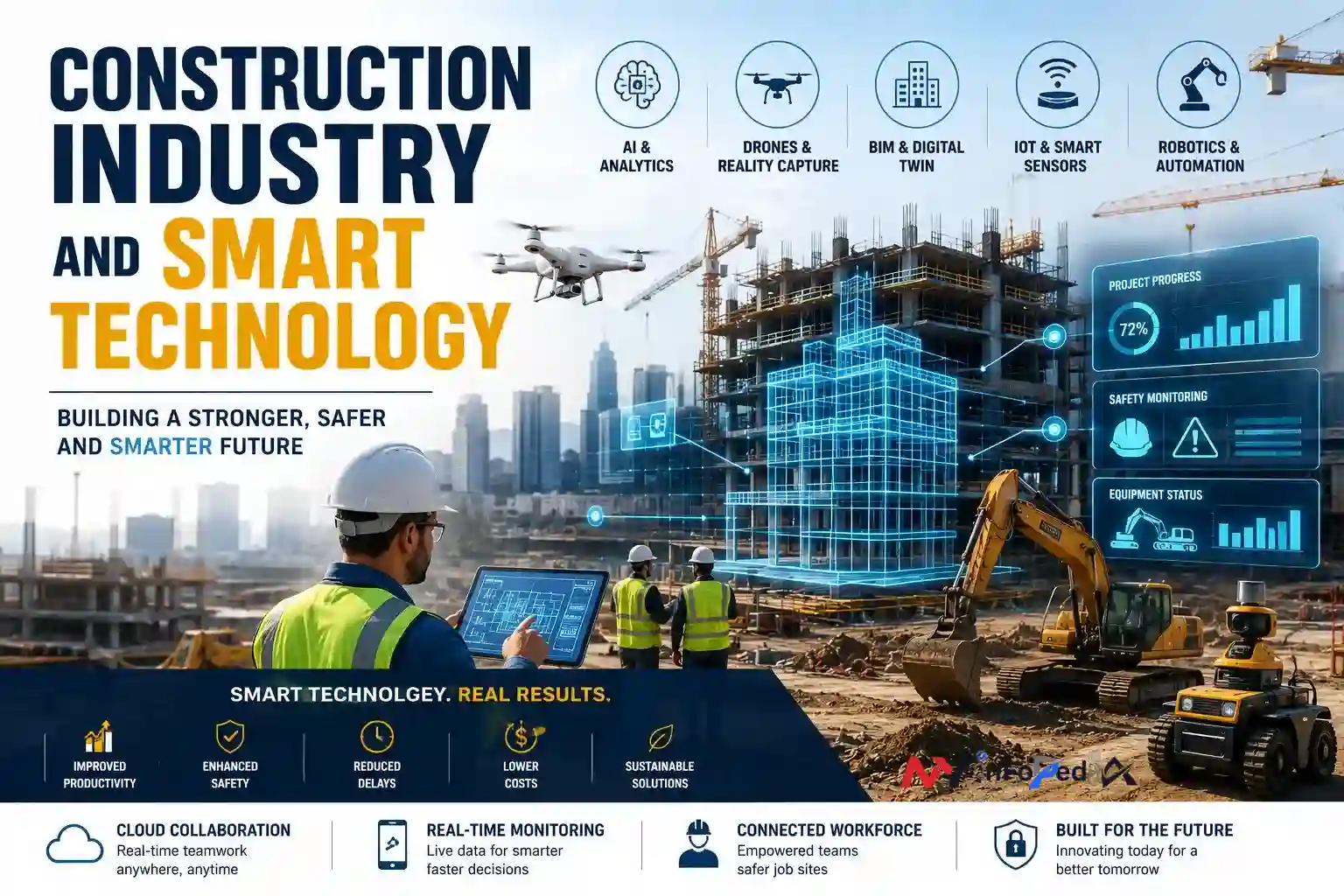
The construction industry has never been known for moving quickly. Steel, concrete, permits, inspections, labor coordination, weather delays, and budget headaches tend to slow everything down. For decades, many construction sites operated with clipboards, paper blueprints, radio calls, and reactive problem-solving. Then digital technology arrived, quietly at first, and now it is reshaping nearly every stage of construction.
Today, smart technology in construction is no longer an experimental concept reserved for futuristic mega-projects. It is becoming part of everyday operations across commercial buildings, infrastructure projects, industrial developments, and even residential construction. Artificial intelligence, IoT sensors, drones, robotics, BIM software, digital twins, and automated monitoring systems are changing how projects are designed, managed, monitored, and maintained.
What makes this shift especially important is not the technology itself. The real story is what these tools solve. Construction companies are under pressure to finish projects faster, reduce waste, improve worker safety, lower operational costs, and meet sustainability targets. Smart technology helps address all of those challenges simultaneously.
What Is Smart Technology in Construction?
Smart construction technology refers to the use of connected digital systems, automation, data analytics, and intelligent devices throughout the construction lifecycle. These technologies collect real-time information, automate repetitive tasks, improve communication, and help teams make faster decisions with fewer mistakes.
Instead of relying entirely on manual reporting or delayed updates, construction teams can now monitor projects continuously through live dashboards, cloud platforms, sensors, drones, and AI-powered software.
A modern construction site may include:
- IoT sensors tracking temperature, dust, vibration, and worker movement
- Drones capturing aerial progress images every morning
- AI software forecasting delays before they happen
- BIM platforms coordinating architects, engineers, and contractors
- Wearables monitoring worker safety
- Robotics handling repetitive or dangerous tasks
- Digital twins simulating building performance in real time
A few years ago this sounded like science fiction. Now many large contractors consider it standard operational practice.
Why the Construction Industry Needed Digital Transformation
Construction has historically struggled with productivity compared to industries like manufacturing or logistics. According to research from McKinsey & Company, construction productivity growth has remained relatively slow for decades due to fragmentation, inconsistent workflows, communication gaps, and limited technology adoption.
Several long-standing problems pushed the industry toward smarter systems:
| Industry Challenge | Smart Technology Solution |
| Budget overruns | AI forecasting and live cost tracking |
| Project delays | Real-time scheduling and predictive analytics |
| Safety incidents | Wearables, sensors, and AI monitoring |
| Material waste | BIM coordination and digital quantity tracking |
| Communication gaps | Cloud collaboration platforms |
| Equipment downtime | IoT predictive maintenance |
| Environmental impact | Smart energy and resource management |
Construction projects involve thousands of moving parts. Even a small communication error can delay a project for weeks. Smart systems reduce those blind spots.
Core Smart Technologies Transforming Construction
Artificial Intelligence in Construction
Artificial intelligence is becoming one of the most influential technologies in construction management. AI systems analyze enormous amounts of project data to identify patterns humans may overlook.
AI tools can now:
- Predict scheduling conflicts
- Detect cost escalation risks
- Analyze weather-related delays
- Improve labor allocation
- Monitor safety compliance
- Optimize equipment usage
- Automate documentation workflows
For example, companies using AI scheduling platforms can identify likely bottlenecks weeks before they affect project timelines. That changes project management from reactive to predictive.
AI is also increasingly integrated into construction management platforms like Procore and CMiC.
Interestingly, AI is not replacing construction professionals. It is mostly enhancing decision-making. Experienced site managers still matter. In fact, smart systems work best when combined with real-world field knowledge.
Building Information Modeling, BIM
Building Information Modeling, commonly called BIM, has become a foundation of modern smart construction.
BIM creates detailed 3D digital models that contain architectural, structural, mechanical, electrical, and operational data for a project.
Instead of isolated drawings scattered across departments, BIM centralizes project information into one collaborative environment.
BIM benefits include:
- Clash detection before construction starts
- Better design coordination
- More accurate quantity estimation
- Improved project visualization
- Faster change management
- Reduced rework
- Better lifecycle asset management
Imagine discovering a major pipe conflict after concrete has already been poured. That mistake is expensive. BIM helps identify those conflicts digitally before crews even arrive on-site.
Major infrastructure projects around the world now depend heavily on BIM workflows.
Internet of Things, IoT and Smart Sensors
IoT technology connects devices, equipment, and sensors into a real-time digital network.
Construction sites now use IoT devices to monitor:
- Worker safety
- Equipment performance
- Noise levels
- Air quality
- Site security
- Temperature and humidity
- Material movement
- Structural vibration
Wearable technology is becoming increasingly common. Smart helmets, connected safety vests, and location trackers can alert supervisors when workers enter dangerous areas or show signs of fatigue.
Environmental monitoring has also become important due to stricter regulations around dust, noise, and emissions.
One interesting shift is that construction sites are becoming data-producing environments. Every sensor generates information that helps teams make operational decisions faster.
Drones and Reality Capture
Drones have quickly become one of the most practical technologies in construction.
A drone can complete a site survey in hours that previously required days of manual work.
Common drone applications include:
- Site mapping
- Progress monitoring
- Topographic surveys
- Safety inspections
- Roof inspections
- Earthwork measurement
- Stockpile calculations
- Aerial documentation
Drones also improve transparency for project stakeholders. Owners and managers can review live project imagery remotely without physically visiting the site.
Reality capture technologies such as LiDAR scanning and photogrammetry create highly accurate digital representations of construction progress. These systems help compare field conditions against BIM models in real time.
Robotics and Construction Automation
Construction robotics is still evolving, but automation is already improving productivity in several areas.
Robots are increasingly used for:
- Bricklaying
- Concrete finishing
- Welding
- Excavation
- Demolition
- Autonomous grading
- Material transportation
Some autonomous heavy equipment systems can perform repetitive grading operations with remarkable accuracy.
This does not eliminate the need for skilled workers. Labor shortages remain a major issue globally. Robotics mainly supports crews by reducing repetitive physical tasks and improving consistency.
Frankly, very few construction workers complain when a machine handles repetitive concrete finishing under intense summer heat.
Digital Twins and Smart Asset Management
Digital twins are virtual replicas of physical buildings or infrastructure assets connected to live operational data.
Once construction is complete, digital twins continue supporting facility management by monitoring:
- HVAC systems
- Structural performance
- Energy usage
- Occupancy patterns
- Maintenance requirements
This creates long-term operational value far beyond the construction phase.
For example, airports, hospitals, and smart commercial buildings increasingly rely on digital twin systems to optimize maintenance and reduce operational costs.
Smart Construction Safety Technology
Construction remains one of the higher-risk industries worldwide. According to Occupational Safety and Health Administration, falls, struck-by incidents, electrocution, and caught-in hazards remain major causes of fatalities.
Smart safety systems are helping reduce those risks.
Modern safety technologies include:
- AI-powered camera monitoring
- Wearable safety devices
- Proximity detection systems
- Smart PPE compliance monitoring
- Environmental hazard sensors
- Automated emergency alerts
Some systems can now detect whether workers are wearing helmets or safety vests through AI video analysis.
Construction companies are also deploying smart surveillance platforms with thermal cameras, intrusion detection, and remote monitoring systems for theft prevention and site security.
Sustainability and Green Construction Technology
Sustainability is no longer optional in modern construction. Governments, investors, and clients increasingly expect energy-efficient and environmentally responsible projects.
Smart technology supports sustainability in several ways:
| Smart Technology | Sustainability Benefit |
| BIM | Reduces material waste |
| Smart HVAC systems | Improves energy efficiency |
| IoT monitoring | Optimizes resource usage |
| Smart lighting | Reduces electricity consumption |
| Predictive maintenance | Extends equipment lifespan |
| Digital documentation | Reduces paper waste |
| Modular construction | Lowers construction waste |
Smart buildings can automatically adjust lighting, ventilation, and energy usage based on occupancy and weather conditions.
Some modern buildings even monitor indoor air quality continuously to improve occupant health and comfort.
The idea of buildings responding intelligently to human behavior would have sounded excessive twenty years ago. Today it is becoming standard design philosophy.
Real-World Examples of Smart Construction
Several major projects demonstrate how smart construction technology is becoming mainstream.
Crossrail Project in London
The Crossrail infrastructure project used advanced BIM systems and digital collaboration platforms to coordinate thousands of workers, contractors, and engineers across one of Europe’s largest transportation projects.
Smart Stadium Construction
Modern stadium developments increasingly rely on drones, digital twins, BIM coordination, and AI-powered scheduling to manage highly complex construction timelines.
Autonomous Construction Equipment
Companies like Caterpillar and Komatsu have developed semi-autonomous heavy machinery capable of improving excavation precision and reducing operator fatigue.
Challenges Slowing Smart Construction Adoption
Despite rapid growth, adoption is not always smooth.
Many companies still face obstacles such as:
High Initial Costs
Advanced systems, sensors, robotics, and software platforms require investment. Smaller contractors may struggle with implementation costs.
Skills Gaps
Construction companies increasingly need workers familiar with digital tools, data analysis, and smart systems.
Resistance to Change
Construction is traditionally conservative. Many professionals still prefer familiar workflows over new technology platforms.
Integration Complexity
Different software systems often struggle to communicate effectively, creating fragmented data environments.
Cybersecurity Risks
Connected job sites generate massive amounts of operational data. Protecting that information is becoming increasingly important.
The Future of Smart Construction
The next decade will likely accelerate smart construction adoption even further.
Several trends are already emerging:
AI-Powered Predictive Construction
AI systems will become more accurate at forecasting delays, cost risks, and equipment failures.
More Autonomous Equipment
Autonomous machinery will likely expand in large-scale earthmoving, mining, and infrastructure projects.
Smart Materials
Self-healing concrete, sensor-embedded materials, and energy-responsive building components are gaining attention.
Expanded Modular Construction
Offsite prefabrication combined with robotics and BIM could significantly reduce project timelines.
Augmented Reality and Virtual Reality
AR and VR technologies are improving design visualization, safety training, and remote collaboration.
Fully Connected Jobsites
Future construction sites may operate as fully integrated digital ecosystems with live monitoring, automation, and predictive coordination across every operational layer.
Why Smart Technology Matters for the Future of Construction
Construction shapes cities, infrastructure, transportation systems, workplaces, and homes. Yet the industry has long struggled with inefficiency and risk.
Smart technology is not simply adding gadgets to construction sites. It is fundamentally changing how projects are planned, executed, monitored, and maintained.
The most successful construction companies moving forward will likely be those that balance technological innovation with practical field expertise. Data matters, but experienced human judgment still matters too.
Construction will probably never become perfectly predictable. Weather still changes unexpectedly. Concrete still cracks sometimes. Permits still take longer than anyone hopes. But smart technology is reducing uncertainty in ways the industry could barely imagine a generation ago.
And honestly, that may be the biggest transformation of all.
Frequently Asked Questions
What is smart technology in construction?
Smart technology in construction refers to digital tools and connected systems like AI, BIM, IoT sensors, drones, robotics, and automation used to improve safety, efficiency, project management, and sustainability throughout the construction lifecycle.
How does AI help the construction industry?
AI helps construction companies analyze project data, predict delays, improve scheduling, monitor safety risks, optimize resource allocation, and reduce operational inefficiencies through predictive analytics and automation.
What is BIM in construction?
Building Information Modeling, BIM, is a digital 3D modeling process that centralizes project data for architects, engineers, contractors, and project managers. It improves collaboration, reduces design conflicts, and supports better planning throughout construction and facility management.
Why are drones used in construction projects?
Drones are used for aerial surveys, progress monitoring, inspections, topographic mapping, and site documentation. They improve accuracy, reduce manual labor, and provide faster access to site data.
What are the biggest benefits of smart construction technology?
The biggest benefits include improved safety, reduced delays, lower costs, better project coordination, less material waste, increased productivity, stronger sustainability performance, and more accurate decision-making through real-time data.
